


Kenrex is a raw, unflinching piece of theatre which, in January, we’re already thinking is a contender for our top three plays of the year. Sadly it’s almost completely sold out, and tickets are like gold dust.
This is the almost unbelievable story of Ken Rex McElroy, a notorious bigger-than-life bully in Skidmore, Missouri, whose long record of intimidation, theft and violence never saw him spend a night in jail. When he shoots a local greengrocer and leaves him for dead, the small community decides that the law’s failure to bring him to justice demands a brutal, collective response. The narrative unfolds through fragments of testimony, voice recordings and direct address, so you never quite watch a conventional drama but a series of testimony from witnesses.
It’s a one-man, true-crime drama – think crime podcast, with a top rated sound engineer, played out on stage. Jack Holden, one of the two playwrights, performs all roles onstage, supported by an on-stage musician.
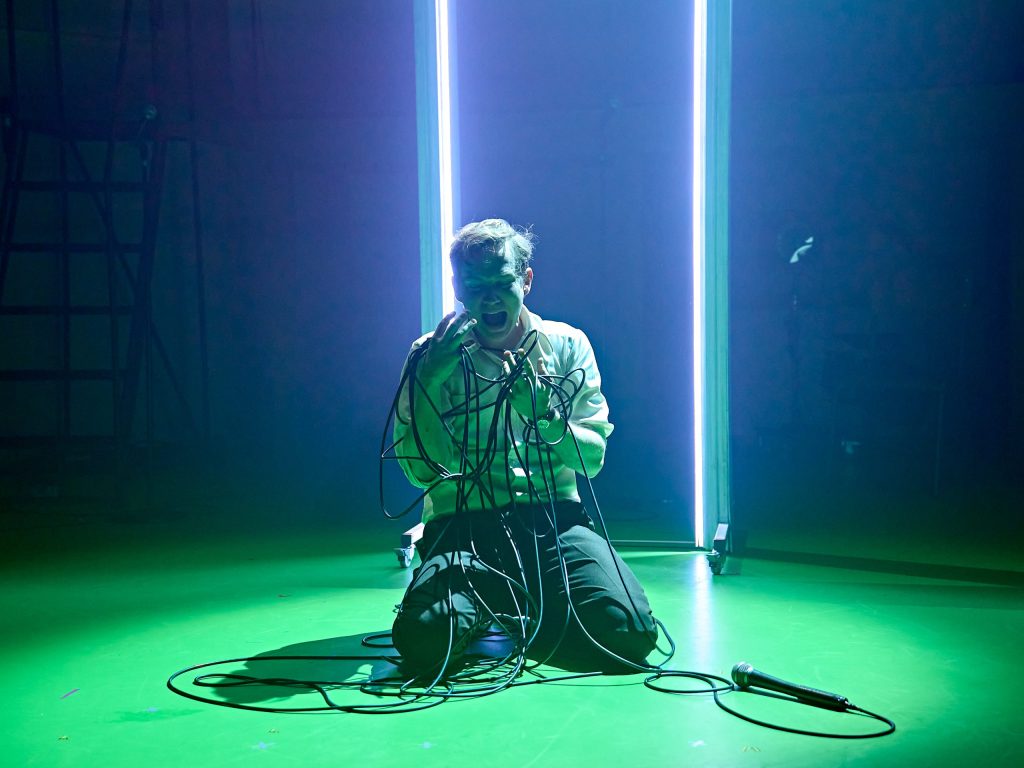
Holden’s central performance defines the evening. He does not lean on costume changes (there are none) or silly voices. Instead, he uses minute shifts of posture, voice and placement at the microphone stands to bring dozens of distinct characters to life. In an early scene titled ‘The Town’, his slight pitch and rapid footwork turn him from a nervous radio DJ into a weary shopkeeper in a heartbeat. Later, in a scene headed ‘The Lawyer’, he holds himself rigid and clipped, the physical equivalent of the slick defence attorney he portrays. These choices make you feel you are not watching impersonation, but witnessing an actor inhabiting the community’s psyche.
The music is more than background. Played live and rooted in folk-Americana rhythms, it feels like wind through prairie grass or the rumble of a distant storm. In one sequence midway through the first act, the guitar becomes almost a narrator, its loops and strums setting a cadence for Holden’s speech that heightens the sense of unease. Sound design gives precision to this effect: voices seem to come from different distances, making the stage feel both intimate and vast.
The writing, by Holden and Stambollouian, tries to balance factual weight and emotional pressure. It leans into the starkness of its subject rather than ornamenting it. Dialogue often feels clipped or circular, as if reflecting the way townspeople speak around fear and shame.

Staging choices enhance this effect without overwhelming the text. The set is minimal: a scattering of microphones and a reel-to-reel recorder against a backdrop that never fully defines the place. Pharo’s lighting sculpts breath and shadow, turning Holden’s silhouette into a looming presence, particularly in scenes around a bare chair late in the second act. These choices keep focus on the narrative’s emotional charge rather than distraction by illusion.
There are three moments you will notice even without knowing the plot. Early on, a recorded interview plays on loop as Holden gradually takes over the narration, collapsing the boundary between witness and storyteller. Midway through, a sequence built around a guitar riff and rhythmic speech feels more like ritual than exposition. Near the close, a sudden quiet after a burst of sound leaves the space feeling unnervingly vast as you process what you’ve seen.
Kenrex connects to current discussions about justice and collective responsibility without overclaiming. It shows how communities can be worn down by fear, and how that same fear can warp moral clarity. The production neither celebrates nor condemns outright; it lays out consequences and lets you sit with the discomfort.
You will love Kenrex if you want theatre that confronts difficult material with clarity and discipline. It’s seriously good.