

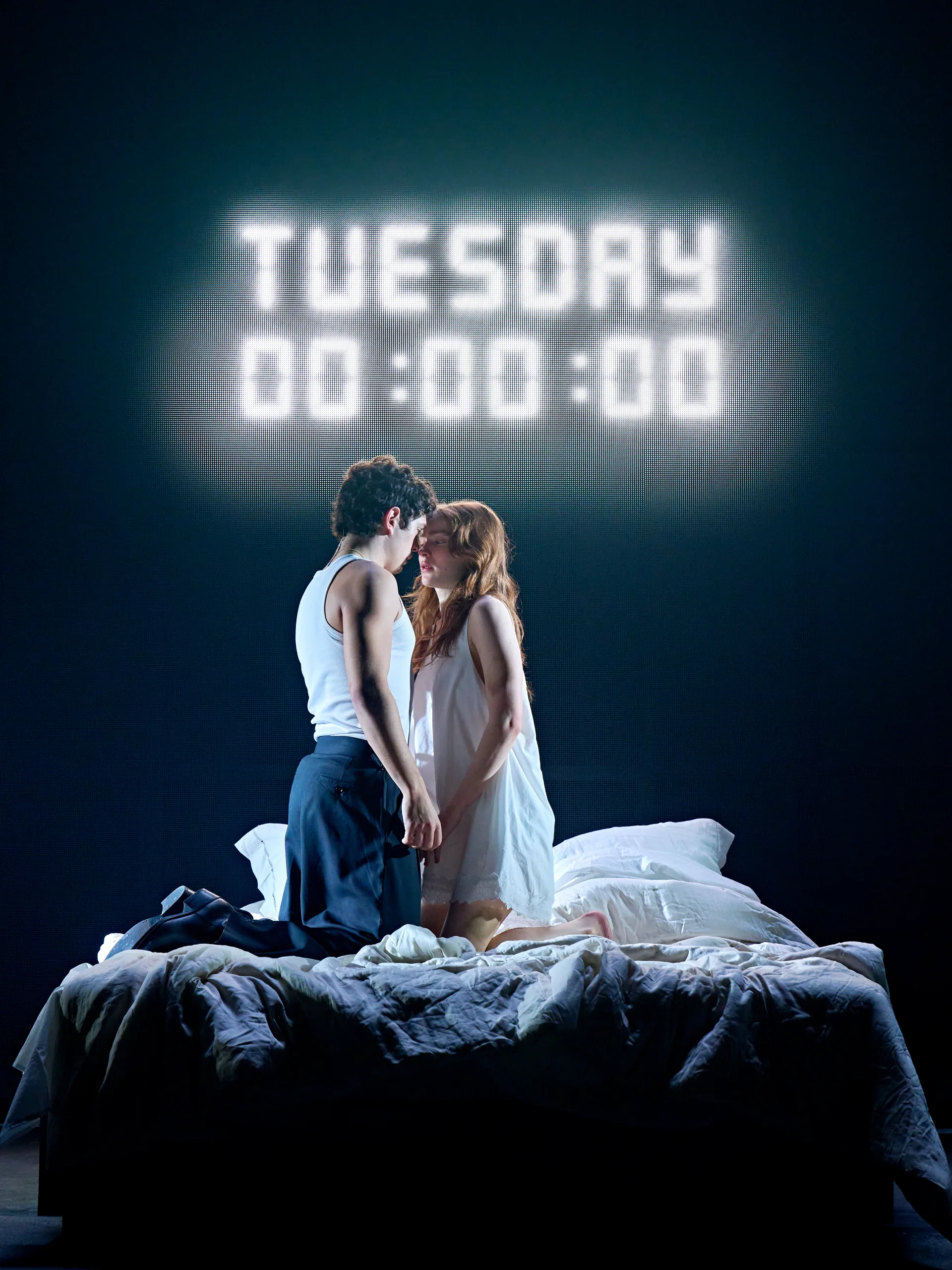
Robert Icke is back in London with another classic text taken apart and reassembled. This Romeo & Juliet at the Harold Pinter Theatre is occasionally too clever for its own good, but it has Sadie Sink at its centre, and that, frankly, is enough.
The strictly limited revival, running until 20 June, hands the title roles to two actors making their West End debuts: Sadie Sink as Juliet and Noah Jupe as Romeo. Verona played out on a stripped-back set of sliding panels, with a digital clock counting down through Sunday, Monday, Tuesday in yellow LEDs.
The famous prologue is gone. The focus is firmly on the interior lives of the young, and the question Icke seems most interested in is: what if it had gone otherwise?
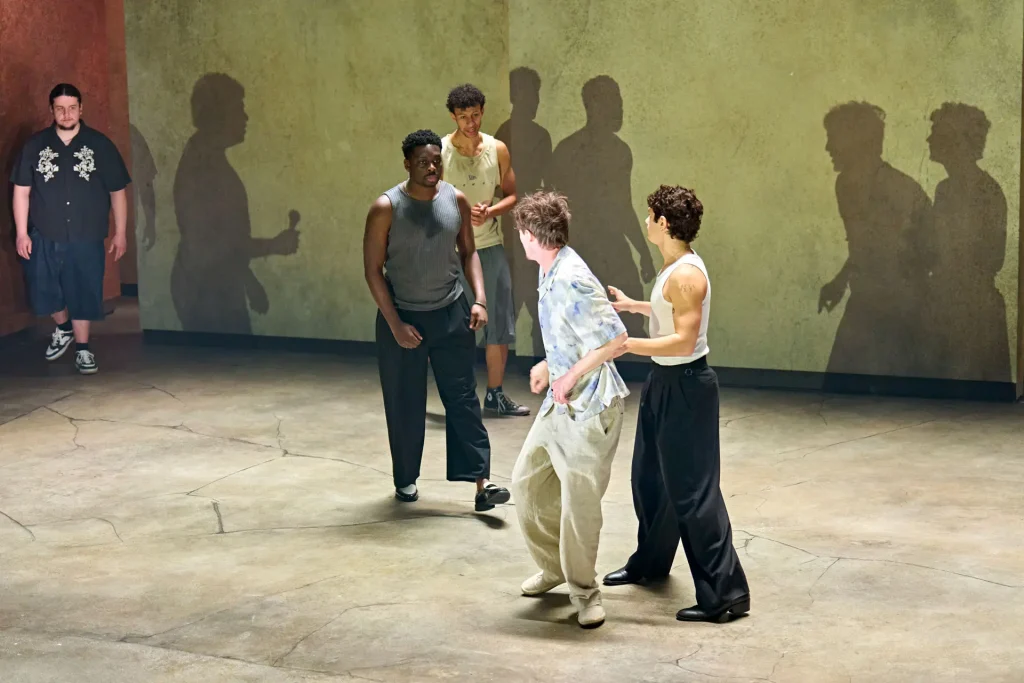
That becomes the production’s central conceit (and it works really well). On a dozen or so occasions, the scene rewinds and replays. The script doesn’t change, but the acting does. A line that read as a tease is now performed as fear; a bantering exchange becomes threats; a kiss is offered rather than taken. The best example is where the messenger, blocked in Shakespeare’s text by the plague, arrives on time to tell Romeo that Juliet is only sleeping; then, of course, we get the version where he fails to arrive. The best ‘what if it had gone otherwise?’ is at the very end, in a long flashback where Juliet briefly walks through the life she could have had. It is hugely emotional and it’s definitely you that was tearing up.
Sink’s Juliet is the reason to see this show. Her skill is, simply, out of this world. She is funny, headstrong, sceptical, eager; exactly the clever teenager you would expect Shakespeare to write if he were writing today. One moment she’s on the bed in the balcony scene, jumping with feet-first abandon, interrupting Romeo’s flowery declarations as if she cannot quite believe her luck. Then, later, she’s half-mad, tipping the friar’s potion down her throat. Jupe, making his stage debut, is more uneven; a sweet, callow boy who occasionally pushes too hard at the text . Yet the chemistry between them is urgent and a touch reckless, which is exactly what these two need to be, and the love scenes are some of the most genuinely passionate I have seen in a West End revival of this play.
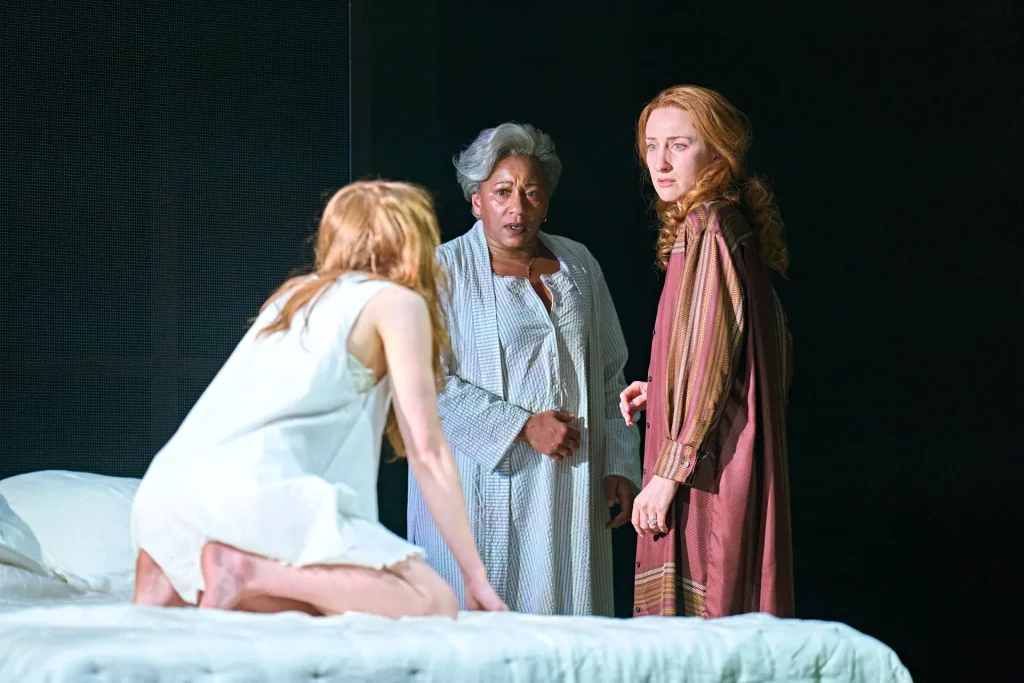
The detail work really does its job. The morning after the lovers consummate the marriage, Clare Perkins’ Nurse arrives, notices blood on the sheets, and folds them over before Eden Epstein’s Lady Capulet walks into the room. It is a tiny domestic gesture which will have been missed by many. There are many moments of that calibre. Clark Gregg makes Capulet a man whose grief over Tybalt curdles into something ugly when he forces Lewis Shepherd’s Paris on his daughter. Kasper Hilton-Hille’s Mercutio is a wired livewire who goads Aruna Jalloh’s Tybalt into the fight that dooms everyone, and John Marquez’s Friar Laurence, meddling pharmacist with the worst postal luck in literature, is sympathetically drawn.
Two things stop the production reaching five stars. First is overuse of the now-standard modern-Shakespeare habit of dropping the stage into darkness and lighting an actor only by a torch beam played across the face. It’s boring.
The second is the ending. I’m still not sure whether to admire it or not. At the close, when the bodies are discovered, there is no reconciliation. The Capulets and the Montagues do not embrace, do not lay down their feud, do not seem to register what has happened. Friar Laurence, who in Shakespeare’s text confesses everything, doesn’t turn up. On the production’s logic, no one opens the tomb again until, presumably, somebody else dies, by which time it is too late for the discovery to mean anything. The lovers’ deaths achieve nothing. The feud continues. The catharsis the script normally provides is withheld. It is bold. I have never seen the play landed quite that way before.
At top West End prices this is a serious ask, but in pure delivery, between Sink, Jupe and Icke’s interpretive nerve, it earns the spend for anyone who likes their Shakespeare reinterpreted with conviction. If you want to see a Juliet who is going to be talked about for years, book.