

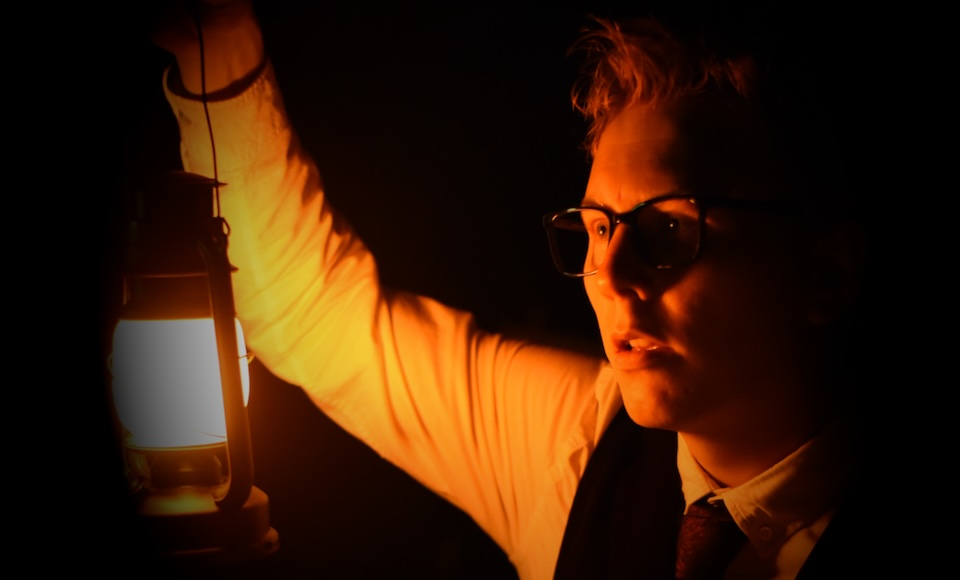
For an hour, David Alnwick has a room at Wilton’s Music Hall eating out of his hand, and he does it with tricks your uncle could have ordered from a catalogue in 1994. Then he picks up Dickens, steps behind a lectern, and the spell he has spent sixty minutes building quietly derails.
The pitch is irresistible on paper. Alnwick, an Edinburgh Fringe veteran who bills himself as an occult illusionist, gives us an evening in two movements: first a parade of Victorian-flavoured magic and mind-reading, then a straight performance of Dickens’s 1866 ghost story ‘The Signalman’. The idea is that the conjuring softens you up and loosens the rational mind, so that when the storytelling begins you are already half-prepared to believe in spectres at the mouth of a tunnel.
That story, for anyone who has not met it, was probably terrifying 160 years ago, but in the age of Netflix it’s a bit meh. A traveller calls down into a deep railway cutting, halloa, below there, and befriends a lonely signalman who guards a stretch of line beside a black tunnel. The man is haunted. A figure keeps appearing by the danger light, his bell rings when no hand has touched it, and each visitation comes just before something terrible happens on the line. The narrator wants to put it all down to overwork and a fevered imagination. The signalman knows better, and the not-knowing is eating him alive. It is the perfect raw material for exactly the kind of theatre Alnwick spends his first hour promising.
It helps enormously that all of this unfolds at Wilton’s, which may be the single most apt room in London for it. This is the world’s oldest surviving grand music hall, a Victorian survivor from Dickens’s own East End, and the auditorium does half the atmospheric work before anyone walks on: slender barley-sugar columns holding up the balcony, plaster left to peel and stain, the whole place conserved rather than scrubbed so the patina of more than a century and a half stays where it fell. A spiritualist conjuror belongs in exactly this sort of space, because halls like this are where Victorian magicians actually plied the trade, and the faded grandeur of the room supplies more genuine unease than the ghost story ever manages to.
What Alnwick does with that first hour is genuinely captivating, and I mean that as a compliment to him and a gentle warning to everyone else. The material is old. Some cards impossibly rising inside a glass or a handkerchief. Correctly predicting whether someone chooses the card with the wavy lines or the square or the circle: these are the standards that have worked sales conferences and after-dinner slots since before the age of the overhead projector. The illusions would give it two stars, if that. In Alnwick’s hands it plays at four. He is warm, fast, and properly funny, the rare performer who can make a volunteer feel like the cleverest person in the building while quietly doing all the lifting himself.
He works the auditorium like a man who has done this five times a day for fifteen Augusts, because he has, and his charisma is the real trick. You forget you have seen every single trick before, because you have never seen them done with this much ease.
And then the magic catalogue closes, we reach the part of the evening the whole thing is named after, and it dies. Alnwick takes up position behind a small lectern in the middle of a bare stage and reads us the Dickens, straight, for what the billing calls 30 minutes and the body experiences as something far longer. There is none of the theatrical sleight he has just spent an hour proving he owns. He simply reads.
I will be honest: I stopped listening somewhere around the first spectral warning and spent the rest of the reading floating gently through my own week, my work, my family, the things I had to do on Thursday. I did not drop off. I rather wish I had, since sleep would at least have moved the clock along. I was not the only one drifting either; over the course of the half hour a thin but steady trickle of people gathered their coats and slipped out into Grace’s Alley, and you could hardly blame them.
You can see what the evening wants to be. The magic is meant to prime you and the story is meant to land the killing blow, illusion bleeding into the genuinely uncanny. The design of it is sound. The execution simply puts all the craft into the first half and all the faith into the second, as though Dickens would do the work unassisted. He does not, at least not like this.
So here is where it settles. Go for Alnwick, who is a generous, charming host and worth the (modest) price on personality alone, and treat the reading as part of the cost of admission. There is a superb show buried in here. Until that night arrives, this is half a triumph and half a long wait for a train that was always going to be late.