

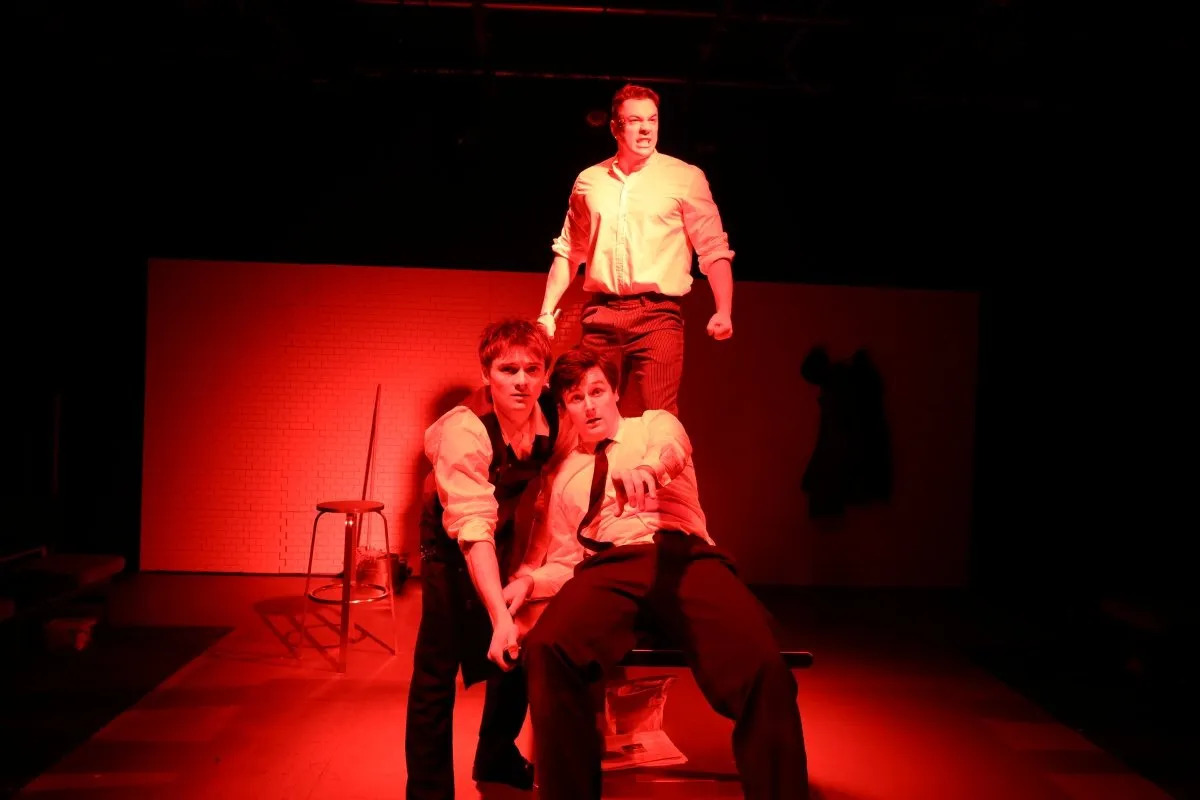
The Grim at Southwark Playhouse Borough is a sharp, uneven night in the mortuary. When it works, it is very funny and properly frightening; when it wobbles, you can feel the stitches straining.
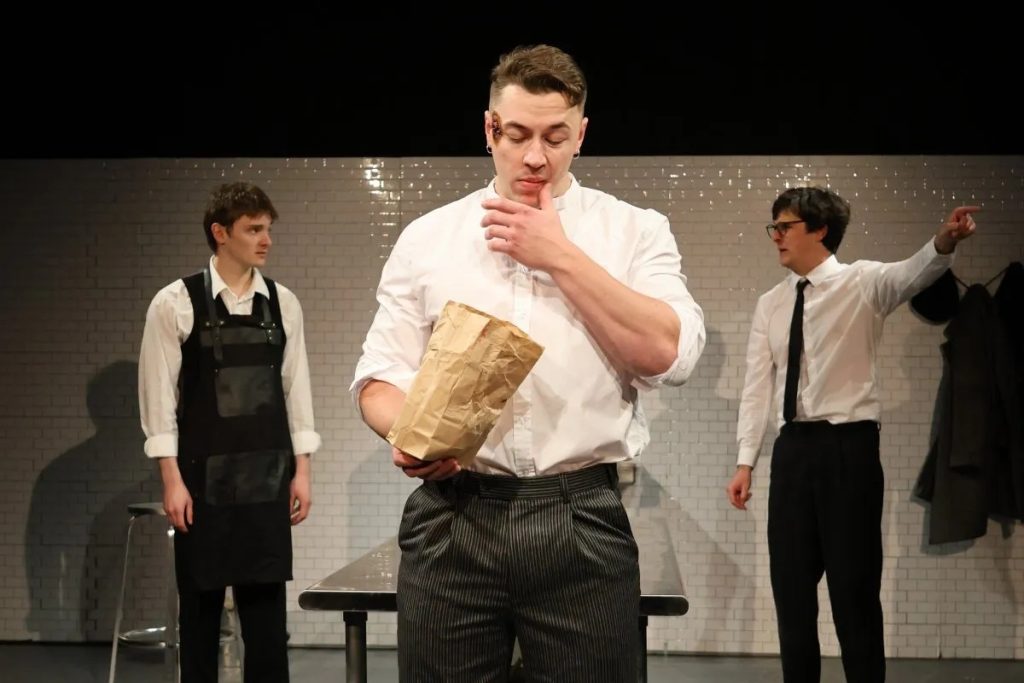
Edmund Morris writes and stars as Shaun, a world-weary undertaker in 1964 East End London, with Louis Davison as jittery assistant Robert and Harry Carter as notorious murderer Jackie ‘the Guillotine’ Gallagher. The set in The Little is a narrow strip of white-tiled mortuary, a steel gurney centre stage, and tools glinting under the gurney. It features two undertakers, a dead gangster and strange noises in the walls.
The first half plays almost like a two-hander crime sitcom. As the lights dim, a radio bulletin about Jackie’s death crackles through the speakers, an opening that knowingly nods to a certain cinema in Buenos Aires. Meanwhile, Shaun shuffles paperwork and snacks on sweets, far too relaxed about bodies, while Robert flinches at every creak and mutters about Irish folklore and a spectral black dog that haunts graveyards.
Morris’s script in this early stretch is packed with clever wordplay and rapid-fire repartee. There is an extended bit where the undertaker has to be “a bit more pacific,” which spirals into a brisk argument over “pacific” versus “specific” that replicates Mitchell & Webb’s famous ‘grammar pedant’ sketch. The banter between Shaun and Robert has the combative, overlapping rhythm of gangsters in Sexy Beast or The Gentlemen, full of petty digs and laddish bravado that hides real fear. One of the biggest laughs comes from a moment of pure bad taste: the assistant leans over the corpse and gives him a schoolyard ‘wet willy’, licking his finger and sticking it into the dead man’s ear. If you appreciate gallows humour, the first half has you well served.
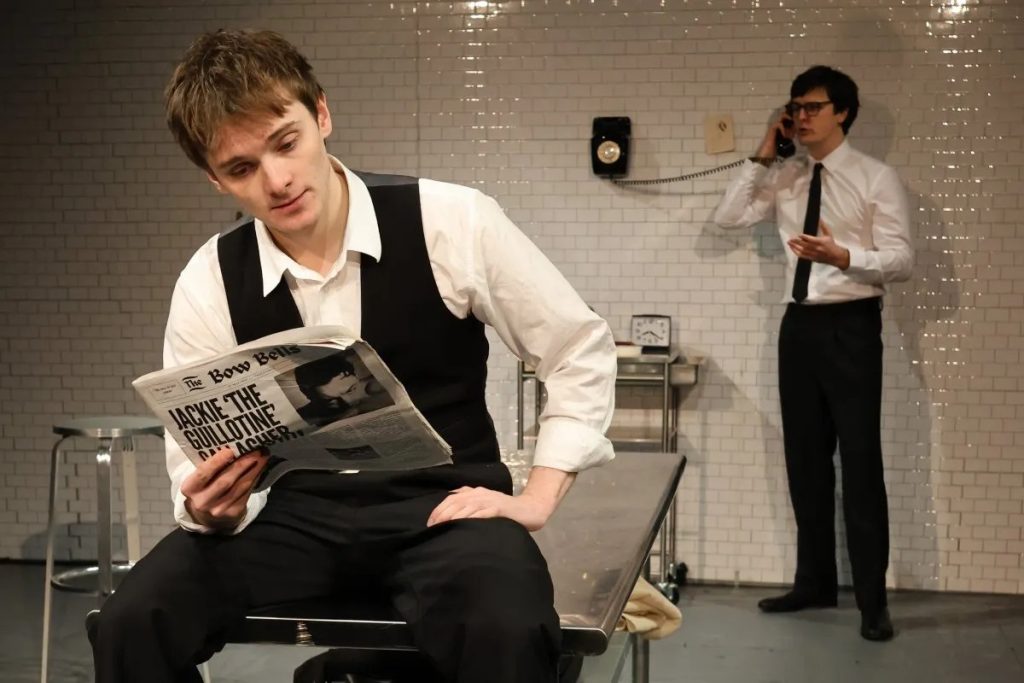
Davison makes Robert more than a comic foil. He hunches into himself, fingers worrying the rosary in his pocket, and snaps his head towards every flicker of light, so you always sense the ghost stories buzzing in his head. When he finally admits how much the job terrifies him, the confession lands because you have seen the nerves in every fumbled cigarette and every half-finished sentence. Morris, as Shaun, leans into a different energy: he treats the bodies as stock to be processed, complaining that he just wants to “stick someone in the ground who doesn’t look like a fucking Toby jug.” That offhand cruelty tells you exactly how numb he has become, and it seeds the later horror more effectively than the jump scares.
Despite the laughs, this is a murder story involving a man who terrified the neighbourhood. When Harry Carter joins the stage, he brings a coiled, mocking charm that makes ‘the Guillotine’ real and menacing, far from a two dimensional pantomime villain.
The shift after the interval is where the play will divide you. The tone bends from wisecracking horror-comedy towards something more serious and unsettling. The second is darker, macabre and noticeably more violent, with images that feel closer to a late-night ghost story or a psychological horror film than to the breezy farce that starts the evening. It would be unfair to spell out what happens, because almost everything that occurs after a key turning point depends on surprise, but the mood changes enough that it feels like a different show.
Here the design team earn their keep. Ali Day’s claustrophobic set does not change, yet Joe Hawkings’s lighting and Fergus Carver’s sound rewire how you read it. In one late scene, the strip lights start to misbehave as the room drops into darkness, leaving only a sickly glow over the corpse while whispers circle the audience. Flickering bulbs and murmured voices are standard horror tools, but in the tight confines of The Little, with the actors inches away, the hauntings feel uncomfortably close. You do not watch the characters being spooked from a safe distance. You feel as if the same environment exists around you.
The writing in the second half does not always keep up with the mood. In trying to turn bantering undertakers into figures in a serious nightmare, Morris sometimes rushes big emotional beats and leans on shock rather than development. There is an aftertaste of two different shows spliced together, and the final line is a remarkably weak ending to an otherwise well written show.
Underneath the tricks, The Grim taps into very current obsessions. It pokes at our appetite for true-crime stories and the way we turn real killers into lurid characters for our entertainment. It shows two working-class men who can only cope with constant proximity to death by mocking it, which chimes with how many people use dark jokes to handle anxiety and loss. There is also a quieter thread about folklore and faith, especially in Robert’s belief in the black dog that stalks graveyards, that brushes against modern conversations about how old stories shape how we think about violence and punishment.
This Southwark staging keeps the same tight one hour length as the original run in Edinburgh (plus an added interval), which is a relief in a world where many Fringe transfers sag under an extra twenty minutes of filler. Here the hour feels cleaner and more deliberate. The pacing gives Shaun and Robert’s odd friendship space to register and lets the supernatural thread seep in rather than jump out of nowhere. The structural split between comedy and horror is still visible, but the production no longer hides behind Fringe scrappiness. Instead it delivers the same lean story with sharper edges, even if the contrast between its two modes remains stark.
If you enjoy smart, foul-mouthed dialogue, strong performances in a tiny space and horror that creeps up behind the jokes, The Grim is worth your time. But don’t be under any doubt: this is a horror show, dressed up a comedy. It is not just a comedy.