


Patrick Marber calls it a masterpiece, but Mel Brooks wrote a vaudeville act. When the curtain lifts at the Garrick Theatre on this gleeful revival of The Producers, you witness execution so precise it borders on ruthless: every gag, every gesture, every swastika-adorned pigeon lands exactly where intended. The problem is that Brooks’ musical comedy about a Broadway producer and his neurotic accountant scheming to stage a guaranteed flop never moves beyond its own clever machinery. Technical brilliance can’t disguise a script that loves itself more than its audience.
Down-on-his-luck producer Max Bialystock hits upon a plan with mild-mannered accountant Leo Bloom: raise two million dollars for the worst show imaginable, watch it close opening night, and pocket the difference. They find their vehicle in Springtime for Hitler, written by delusional Nazi Franz Liebkind. They hire the worst director, cast the most inappropriate performers, and wait for disaster. Instead, audiences embrace the show as satire.
Marber’s production transfers from the Menier Chocolate Factory with an expanded budget but unchanged sensibility. Scott Pask’s set remains deliberately sparse in Max’s dingy office before transforming into gaudy showbiz spectacle during the titular show-within-a-show. Tim Lutkin’s lighting shifts from naturalistic grime to theatrical glare whenever ambition takes hold. Paul Farnsworth’s costumes justify the larger canvas, particularly during Springtime for Hitler, where pretzels and bratwurst meet sequinned fascism in numbers that would horrify their inspiration. Lorin Latarro’s choreography deploys the ensemble with military efficiency, from Zimmer-frame tap routines to mechanised pigeons.
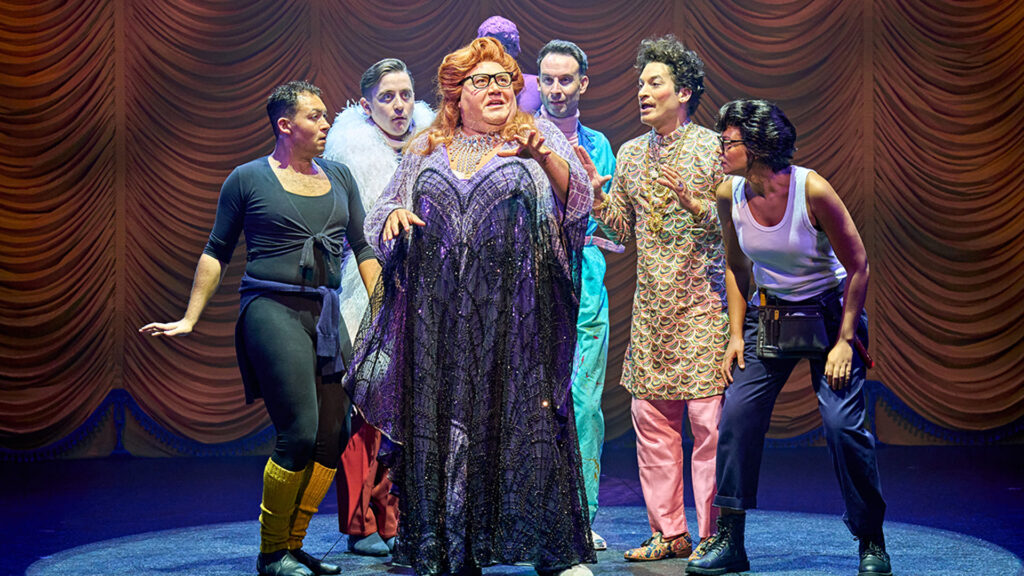
Andy Nyman plays Max as sweat personified, a producer whose desperation renders him simultaneously repellent and pitiable. He anchors the production with comic authority. Marc Antolin’s Leo arrives perpetually three seconds from panic attack, clutching his security blanket through every crisis.
Trevor Ashley steals scenes as director Roger DeBris with an economy that suggests genuine talent beneath the camp. His expressions alone generate laughter; his Keep It Gay number exemplifies how restraint amplifies absurdity. Harry Morrison’s Liebkind is amusing if one-note, playing the Nazi playwright as an overgrown schoolboy. Raj Ghatak brings Julian Clary-adjacent flourishes to common-law assistant Carmen Ghia in what remains essentially a collection of mannerisms.
Then there’s Ulla, the Swedish bombshell secretary whose broken English and improbable curves fulfil every male-fantasy cliché Brooks appears incapable of resisting. Joanna Woodward sings beautifully and brings unexpected agency to a character written as decoration, but the material defeats her. Ulla serves no plot function. She grates not through performance but through conception: Brooks couldn’t write a woman who exists for reasons beyond men’s desires. That limitation pervades his work, turning would-be satire into the thing it claims to mock.
Brooks’ score demonstrates fluency in musical comedy vocabulary without achieving memorable melody. I Wanna Be a Producer references My Fair Lady’s You Did It. Keep It Gay mines every theatrical stereotype about gay directors without landing anywhere beyond the obvious. Springtime for Hitler itself works because bad taste executed with conviction becomes its own reward, not because the songs possess staying power. Brooks understands the machinery of Broadway but lacks genuine feeling for it, producing pastiche that winks at its own cleverness.
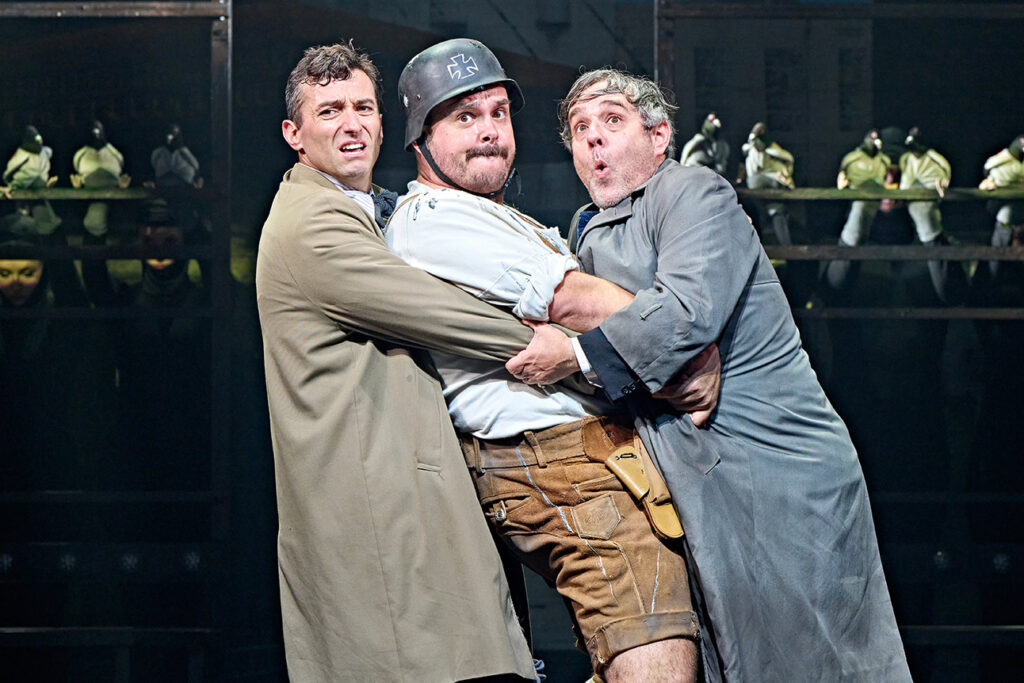
The production moves at calculated speed under Marber’s direction, never permitting contemplation that might reveal the emptiness beneath. Every pause gets filled with physical comedy. Every lull prompts another sight gag. Watch carefully and you’ll spot the anatomically correct statue, the swastika-branded pigeons, the inappropriate confetti drop. These details demonstrate meticulous craft and exhausting self-regard.
The show’s timing feels unfortunate. In 2004, when The Producers last played the West End, fascism registered as a historical nightmare suitable for mockery. Today, far-right nationalism surges across democracies whilst this production treats Nazism as absurd rather than dangerous. Brooks’ assumption that decent society would automatically reject Springtime for Hitler belongs to an America that no longer exists, if it ever did.
The Garrick Theatre accommodates the production better than the intimate Menier space, allowing the big production numbers room to breathe without overwhelming the comedy beats. Yet the additional scale exposes how little substance supports the spectacle. Comparison with the film versions proves instructive: Zero Mostel and Gene Wilder inhabited their roles with manic desperation that felt dangerous. Nyman and Antolin hit their marks with skill but safety.
The Producers succeeds as professional entertainment whilst failing as meaningful art. It delivers what audiences expect from expensive West End musicals: polish, precision, and predictability. If that satisfies you, the production achieves its goals admirably. Those seeking work that challenges or illuminates will find Brooks’ self-satisfied comedy hollow at its core. Technical mastery without emotional truth produces theatre that dazzles momentarily before evaporating from memory. This revival confirms what should have been obvious: some shows belong to their moment, and that moment passed years ago.