

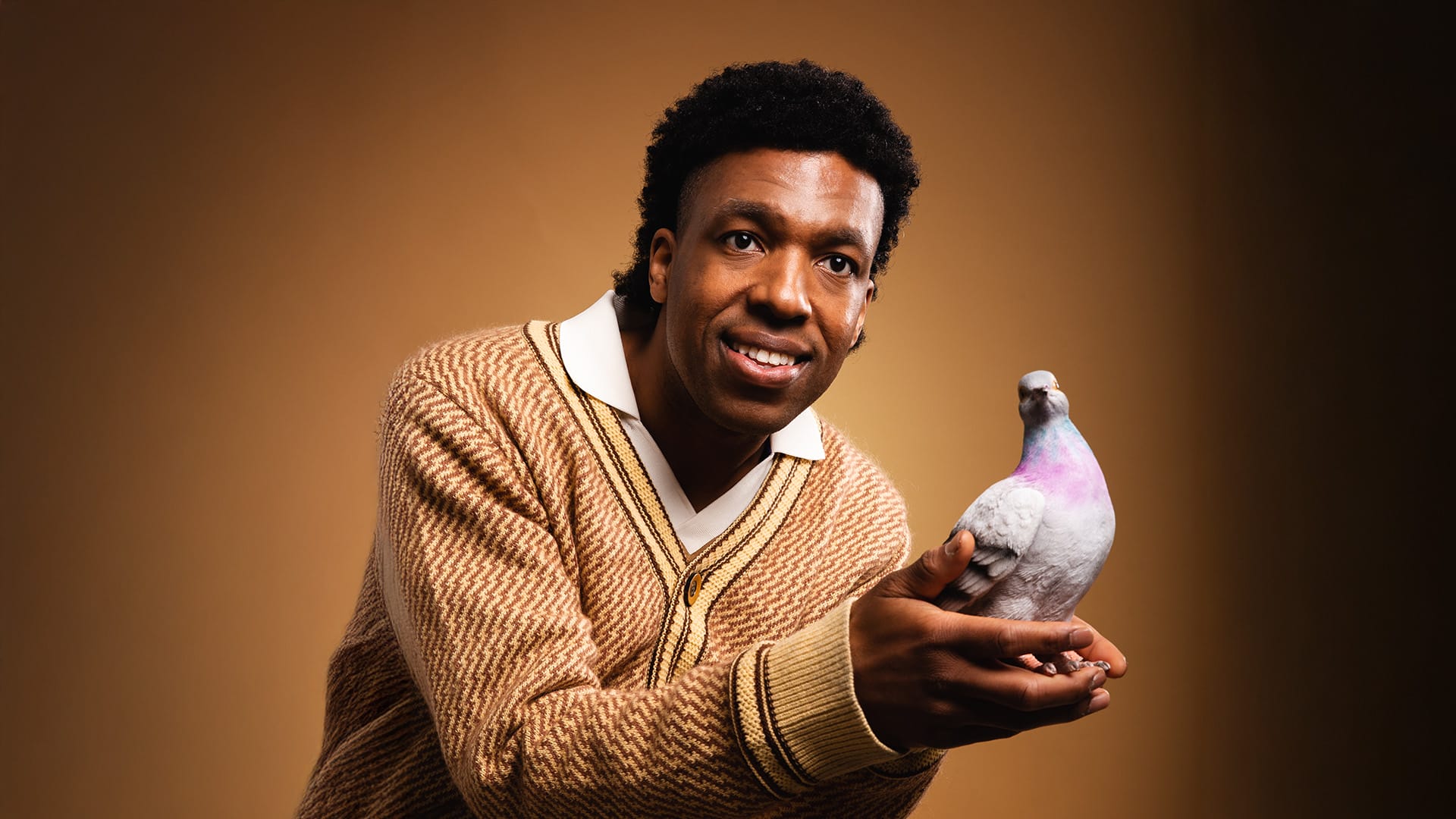
Toussaint Douglass arrives at the Soho Theatre trailing acclaim from Edinburgh, where his debut hour earned a Best Newcomer nomination and sold-out audiences. The show that greets London, however, raises uncomfortable questions about where playful crowd work ends and aggressive confrontation begins.
This is stand-up comedy that trades heavily on absurdist charm. Douglass, a Lewisham-born performer with binoculars and an attaché case, opens by positioning himself as a fellow birdwatcher eager to share pigeon facts. A stuffed bird strapped to a remote-controlled car whizzes chaotically around the space while volunteers attempt to feed it bread. The premise delivers exactly what it promises: roughly ten minutes of ornithological material wrapped around a more personal exploration of family, neurodivergence, and inherited oddness.
Douglass grew up raised by his 87-year-old Dominican grandmother, a Windrush immigrant for whom pigeons symbolised Britain when she first arrived. He uses this detail as scaffolding for wider reflections on generational weirdness versus generational trauma, asking whether the quirks passed down through families carry the same weight as their wounds. His father appears as an emotionally distant figure, explored through role-play sequences involving audience participation. His partner, a clinical psychologist, is framed as the decision-maker in their relationship, a dynamic Douglass presents as resembling a boss-employee arrangement. The pigeon material itself argues that the bird deserves recognition as a national emblem, a working-class survivor thriving despite hostility.
The crowd work, however, crossed troubling lines during this performance. Douglass repeatedly targeted two elderly men in the audience, returning to them multiple times throughout the hour. His approach involved getting his face into their personal space and shouting aggressively at close range. One man displayed visible signs of discomfort that suggested possible mental health vulnerabilities. Rather than reading the room and redirecting, Douglass intensified his engagement with these individuals, creating an atmosphere of discomfort that extended beyond the targeted volunteers to the wider audience.
This behaviour fundamentally contradicts the sweetness and generosity that characterised the Edinburgh run. Skilled crowd work requires sensitivity to power dynamics and an ability to gauge when playfulness tips into bullying. Targeting vulnerable audience members repeatedly, particularly elderly men who cannot easily defend themselves or leave, represents a failure of both comedic judgment and basic empathy.
Douglass performs with what is often described as controlled awkwardness, a style frequently compared to Richard Ayoade. His delivery is outwardly nervy but underpinned by assurance. He moves between sections of the stage with manic energy, a physical embodiment of the tension between introversion and the need for visibility. When the crowd work functions well, this nervous energy translates into deft adaptability. When it misfires, as it did here, it reads as aggressive rather than playful.
The show wrestles with focus even when the crowd work lands appropriately. It cannot quite decide whether to lean into absurdist pigeon premise, excavate uncomfortable family truths, or settle for gentle affection. A sequence about his grandmother’s fire-and-brimstone childrearing hints at deeper complexity but does not pursue it with necessary ferocity. Douglass is too kind to his material in some moments, too cruel to his audience in others. The imbalance undermines the thesis that his family has made him odd and he has made peace with that. Peace requires self-awareness, and self-awareness includes recognising when you are causing harm.
At a moment when conversations about neurodivergence and otherness dominate comedy and wider culture, Douglass offers a perspective that feels both timely and personal when confined to his own experience. He does not overstate or claim universality. He simply presents his life as one shaped by difference. The problem arises when that presentation requires other people to become unwilling participants in a dynamic they did not consent to and cannot easily escape.
The show sold out its Edinburgh run and earned Douglass significant critical praise. That success rests on the assumption that the charming awkwardness and oddball sincerity remain charming rather than weaponised. Comedy requires risk, but risk-taking must be directed at those who can withstand it or who have volunteered for it with full awareness. Elderly audience members showing signs of vulnerability are neither.
Douglass is still finding his voice, still deciding what kind of comedian he wants to be. The material about pigeons and family ghosts suggests a performer capable of warmth and insight. The aggressive crowd work suggests someone who has not yet learned when to stop. Until that lesson lands, the show remains a promising debut undermined by its worst instincts.