

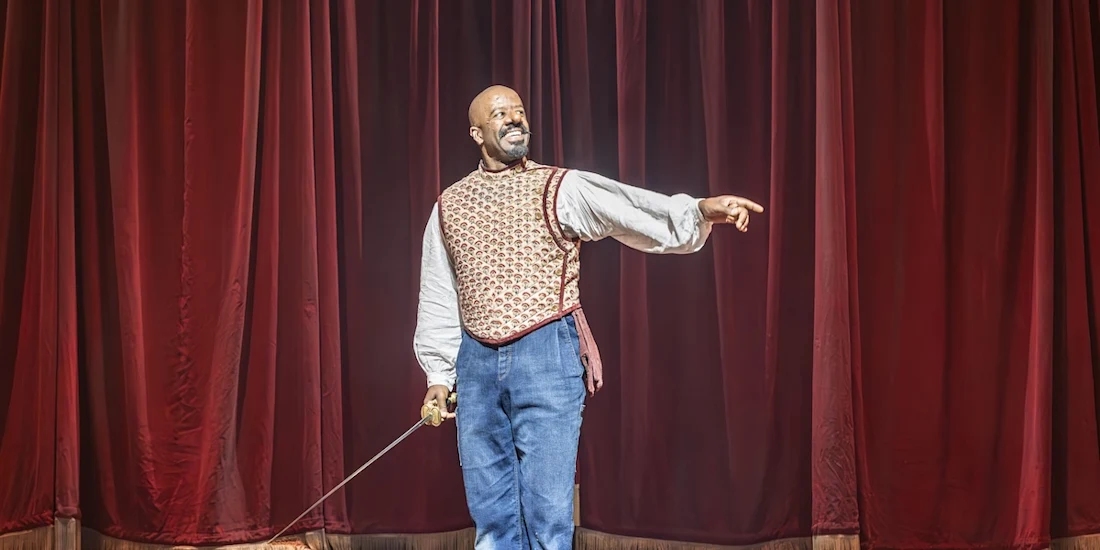
Somewhere inside this Cyrano de Bergerac sits a five-star evening: a script that fizzes, a company acting at full stretch, and a title role played, on the night I saw it, by a man whose name I cannot tell you. The trouble is that the five-star evening comes bundled with a director’s cut nobody asked for.
Edmond Rostand’s 1897 romantic tragicomedy, newly adapted for the RSC by Simon Evans and Debris Stevenson and directed by Evans, arrives from Stratford with the story restored to Paris in 1640, the Thirty Years’ War grumbling away in the wings. Cyrano is a soldier, poet and philosopher who walks as he pleases and speaks as he dares. He is also, the play insists, saddled with a nose of such continental proportions, a cape, a peninsula, practically a landmass with its own weather system, that he believes no woman could ever love the face it sits on. Hold that thought. I will be returning to the nose.
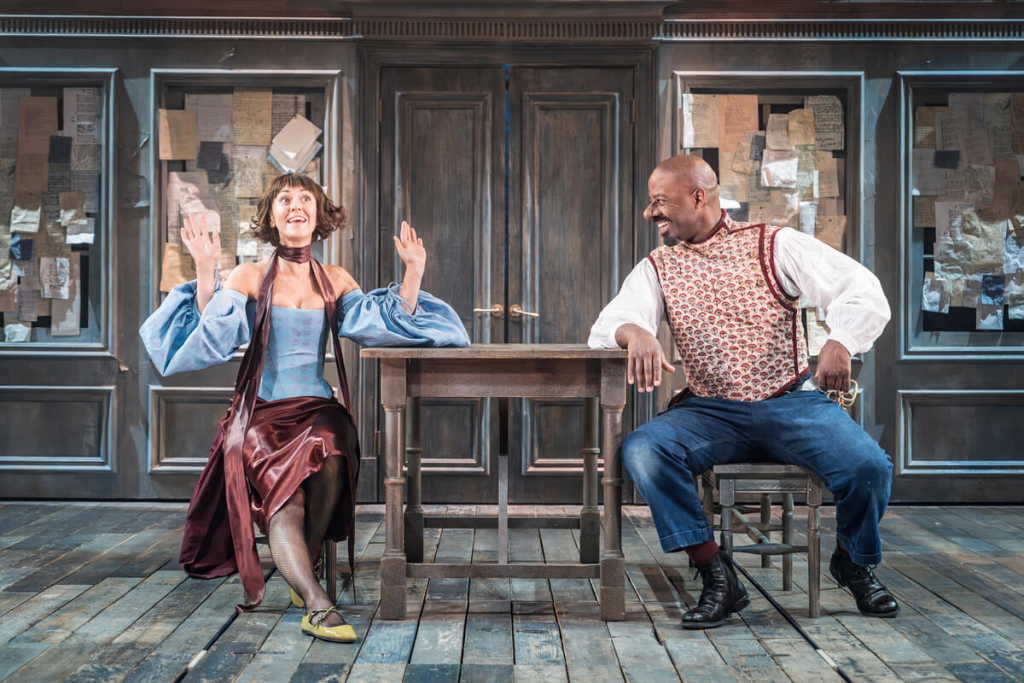
When his luminous childhood friend Roxane confesses she has fallen for Christian, a handsome new cadet in Cyrano’s own company, Cyrano strikes the most self-defeating bargain in French drama. Christian has the face but no words; Cyrano has all the words in France. One will supply the poetry, the other the profile, and Roxane will fall for a man who does not exist. The deception holds through love letters, a battlefield and years of consequence, and Evans stages it with terrific brio. The evening begins in cheerful chaos, with Christian Patterson’s Ragueneau hauling the stalls to their feet, an actor loudly failing to find his way out of the auditorium, and a six-piece band wandering on because, it emerges, Cyrano has won them in a wager. The musicians stay all night, and Alex Baranowski’s score becomes a second language for a play about the things people cannot bring themselves to say.
Now, the delicate matter of billing. On 22 July, the performance being reviewed, Adrian Lester took a scheduled night off and his understudy went on. His name appears nowhere on the production’s website and I failed to write it down, so his triumph goes uncredited, which is either a small scandal or the most committed piece of thematic staging in London. This is, after all, a play about a brilliant man doing his finest work under somebody else’s name. Whoever he is, he commanded the Act One duel, composed line by line as the swords fly, with the swagger of a man who has spent months waiting for exactly this phone call. And beneath Roxane’s balcony he let the words come haltingly at first and then cascade, so that you heard a man discovering he is allowed, just once, to mean everything he says.
The rest of the company matches him. Susannah Fielding’s Roxane arrives soaked from the rain and never loses that first flash of spontaneity, travelling from girlish delight to something far darker without changing gear. Levi Brown plays Christian’s stupidity absolutely straight, which is the right call; a Christian performed for laughs lets everyone off the hook, and this one makes the deception crueller. Scott Handy’s Comte de Guiche is a gloriously seedy villain.
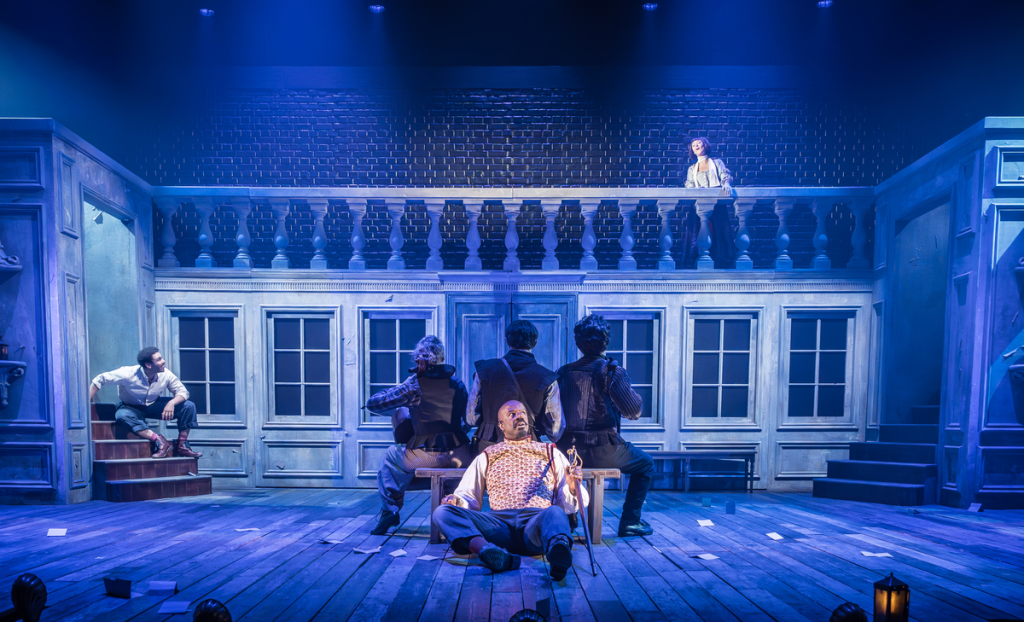
Stevenson and Evans let verse melt into prose and back without a visible join, every character has his own verbal fingerprint, and the wordplay glitters. The programme reveals that Cyrano is forbidden from ever using a cliché; the production compensates by never using one scene where three will do. Beat after beat lands, then lands again, then takes a bow. The historical siege of Arras dragged on for the better part of 1640, and the second half recreates it with a fidelity the production elsewhere never attempts. By the final movement the evening has spent so much of its capital that the ending, which should devastate, has to compete with the audience checking their watches. Somebody needed to take a blue pencil to this script with the ruthlessness Cyrano takes a rapier to fools, and nobody did.
And then there is the nose, or rather there isn’t. Cyrano’s hooter is meant to enter a room a quarter of an hour before he does. From row O of the stalls, two-thirds of the way back, this one barely entered at all: a perfectly ordinary nose having a slightly bad day. I understand the reasoning, since nobody wants a comedy conk upstaging the poetry. But the play’s entire engine is a disfigurement so overwhelming that it is all anyone sees, and here you cannot see it without binoculars and an act of faith. Jamie Lloyd’s 2019 production cut the nose entirely and turned the affliction inward, into corrosive self-loathing. This production hedges, handing its hero a flaw too small to spot from anywhere further back than the front row, and asking us to believe nobody can look past it. What remains is a Cyrano whose problem exists entirely in his own head, which is not the play anybody on stage is performing.
So: phenomenal acting, a phenomenal script, and an evening that outstays a welcome it worked very hard to earn. If you go, book near the front, bring provisions, and pack panache for the long haul.