

Mischief have smuggled their Cold War caper back into the West End after a sell-out run last year, and it remains one of the most precisely engineered comedies in London.
Written by Henry Lewis and Henry Shields and directed by Matt DiCarlo, it opens with MI6 agents whose code names are single letters, producing several minutes of exasperated people insisting they mean not U but you. The silliness of the evening is established inside ninety seconds.
Everything will be a misunderstanding. Every misunderstanding will come back. Plans for a weapon called Project Midnight go missing courtesy of a rogue British agent, and the CIA and the KGB converge on the fictional Piccadilly Hotel to reach them first.
What they find there is a switchboard of crossed wires. Bryony Corrigan’s Elena Popova is a KGB professional saddled with Chris Leask’s Sergei Ivanov, who craves the double life far more than he can manage it. Dave Hearn’s Lance Buchanan works the American end alongside his mother Janet, a retired operative whom Nancy Zamit plays with the beaming pride of a woman at a school sports day. Into the middle of this walk Henry Shields’s Bernard Wright, a baker who has brought his girlfriend Rosemary (Adele James) to the hotel intending to propose, and Henry Lewis’s Douglas Woodbead, a thundering old ham auditioning against Sean Connery for the first James Bond picture. Greg Tannahill’s manager Albert Tipton attempts to run a hotel through all of it, with an inspection looming.
Lewis supplies the evening’s finest sustained joke. Woodbead rehearses James Bond’s introduction and martini order repeatedly and gets them fractionally wrong every time, and Lewis’s choice is to deliver each mangled version with the total conviction of a man certain he has nailed it. He never signals the error and never invites the laugh. That is precisely why the running gag survives a whole evening instead of expiring after three goes. Shields plays Bernard almost entirely straight against all this. Somebody in the building has to want something ordinary, and his baker’s expletives (crumpets being the strongest language he can locate) land for being sincerely meant.
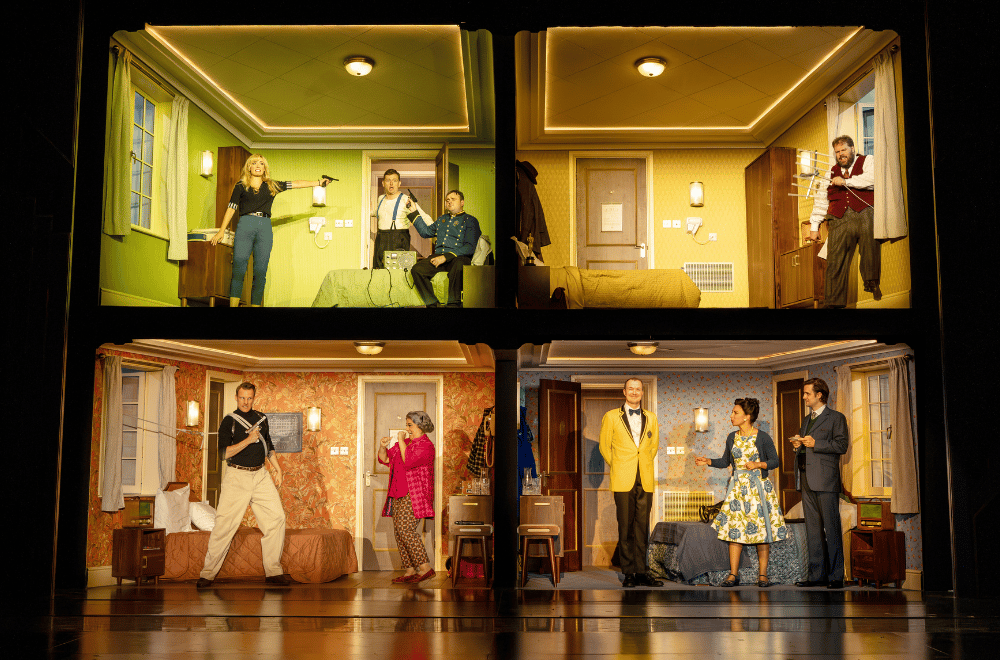
David Farley’s set does the heavy lifting in the first half, splitting the hotel into four colour-coded bedrooms stacked two by two, a doll’s house cutaway that lets you watch four disasters develop at once while each occupant remains blissfully unaware of the other three. It is a genuinely brilliant piece of stagecraft and the company move through it with the coordination of a Swiss movement, bugged radios travelling between rooms, and telephone cords doing work no telephone cord should be asked to do. But it outstays its welcome. The sequence runs and runs at one pitch, on one picture, and I eventually found myself admiring the choreography rather than laughing at it, which is not the same experience. Ten minutes trimmed and the first act would be close to flawless.
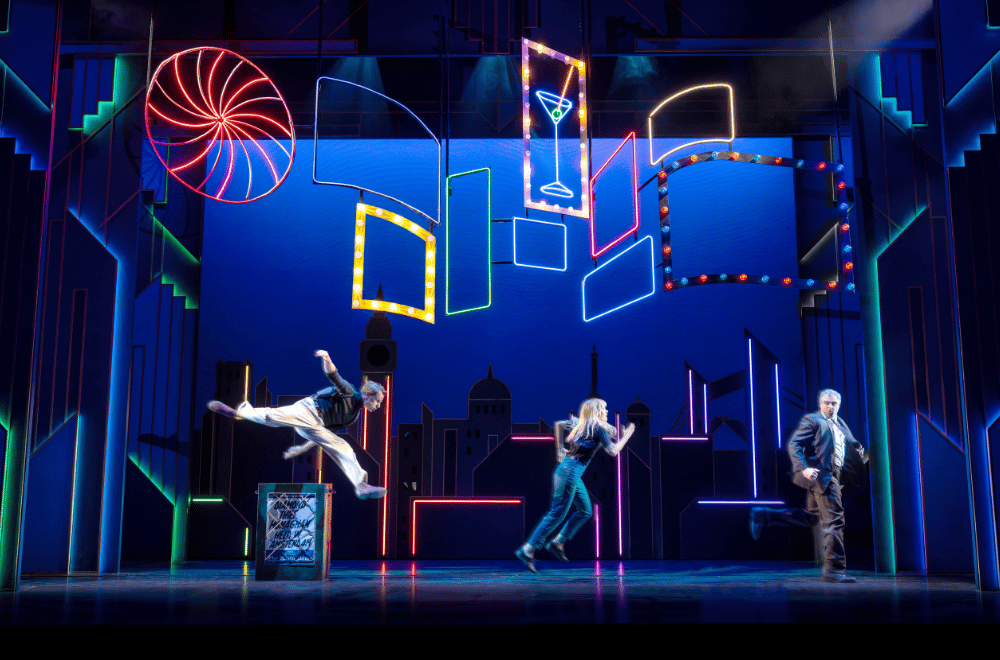
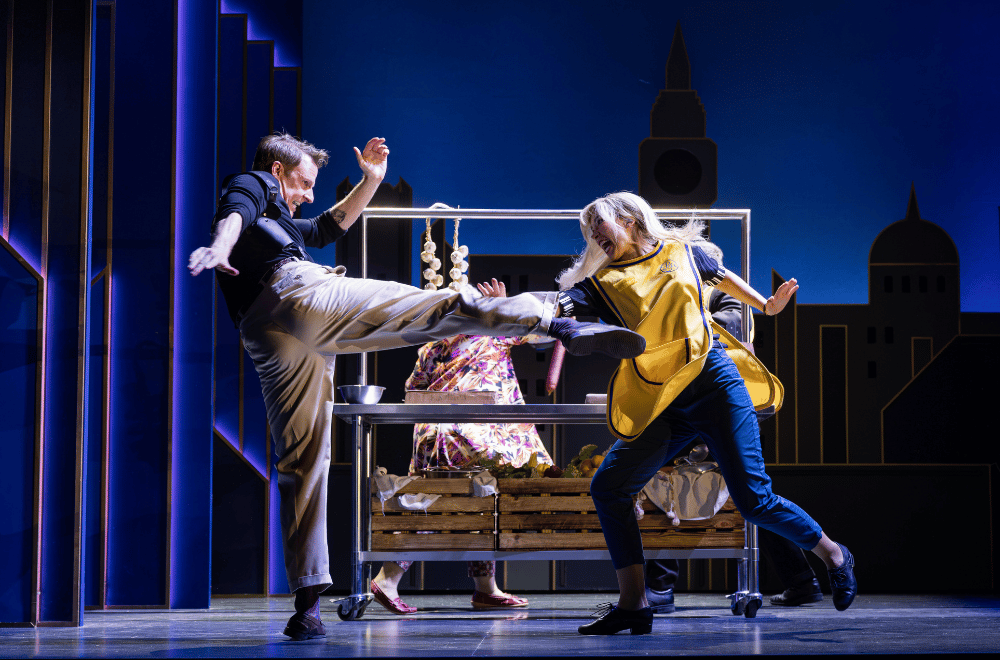
The fight work is a wonderful surprise. There is a set-to between the trained operatives that is played with real martial precision, quick, lethal and beautifully clean, and it is immediately answered by a scuffle between two people who have clearly never hit anything, all flapping wrists and pantomime laps of the furniture. Setting the two side by side is the sharpest thing in the production, because the joke is not the incompetence on its own but the contrast, and Greg Tannahill’s (who doubles as fight capitain) movement direction gets full value from both halves of it
The script is consistently sharp, and clever. Punchlines get planted several scenes before they detonate, homophones are worked to the point where sweet and suite become genuinely funny, and the whole thing is built with the rigour of an Aldwych farce wearing a trench coat. The weakness is appetite. Certain gags are stretched past their natural span, and the second half loses a little of the first half’s shape as the design grows busier. This show is escapism rather than the emotional sleight of hand of Operation Mincemeat, and it does not pretend otherwise.
Small quibbles against a large amount of pleasure. The company are extraordinarily good at this, the Adelphi’s bigger auditorium suits the doll’s house better than the Noël Coward did, and the laughs arrive at a rate that would embarrass most other comedies in town. Eight weeks only, which is your cue. The name is Mischief, and they have not lost their touch.