


There is a moment in Oh, Mary! when Mason Alexander Park, crinoline swaying like a circus tent in a gale, simply cannot work out how to climb down from a desk. The audience falls apart. Whether that image strikes you as the most joyfully absurd thing you’ve seen all year, or as an elaborate exercise in nothing much, tells you most of what you need to know before you buy a ticket.
Cole Escola’s dark comedy, which won two Tony Awards on Broadway and landed a Pulitzer Prize nomination, arrives at the Trafalgar Theatre in a West End production directed by Sam Pinkleton, who steered the original. The premise is bracingly simple: Mary Todd Lincoln, First Lady of the United States, is a miserable, hard-drinking, would-be cabaret star, trapped in the White House in the weeks leading up to her husband’s assassination. She wants the stage. She wants freedom. She wants, in no particular order, adoration, another drink, and someone to blame. What history gave her instead was proximity to power and a front-row seat at Ford’s Theatre. In Escola’s telling, that is almost unbearably funny.
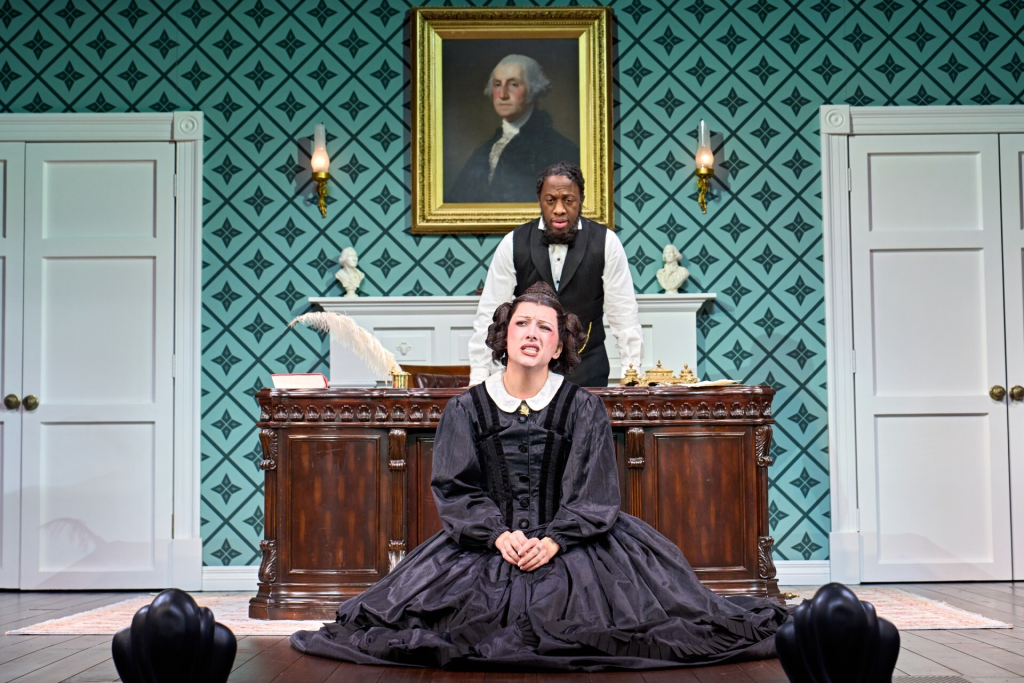
The play is structured as a series of sharp vignettes, each punctuated by a sudden blackout and a melodramatic piano chord, giving the whole thing the rhythm of a live-action cartoon or a deranged sitcom. Escola, describing themselves in the programme as an idiot, declines historical accuracy as a guiding principle from the very first scene, and the production commits fully to that position. The set, designed by the collective dots, is a deliberately cartoonish version of a presidential office, two large doors on either side of the action that announce from the start: this is a farce, and it is unashamed of itself.
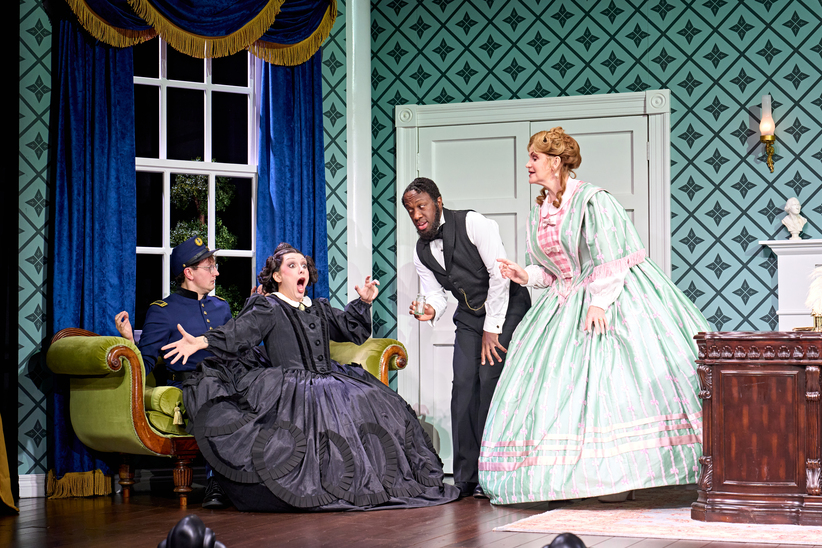
Park’s performance is the engine of the evening and, quite possibly, the best thing currently happening on a West End stage. They barrel through the role at full tilt, their ringlet wig, created by Leah J. Loukas and now practically a character in its own right, bobbing with every dramatic entrance. When Mary is teaching her husband’s assistant how she expects to be treated, Park’s comic timing is almost geometrically precise, a masterclass in making a single withering expression pay off for fifteen seconds longer than any reasonable person would think possible.
By contrast, Giles Terera, as Mary’s Husband, plays Abraham Lincoln as a man of enormous dignity and absolutely no idea what to do with his wife. Terera abandons his customary nuance in favour of exasperated ham, and the effect is genuinely funny in the early scenes. Kate O’Donnell’s Chaperone, Louise, absorbs punishment with a commitment that borders on saintly, while Dino Fetscher’s acting teacher brings a quietly desperate energy to scenes that need grounding amid all the chaos. Oliver Stockley, as the assistant, provides Terera’s character with a foil whose presence explains rather a lot about why Abe Lincoln might be distracted.
Escola’s writing is at its sharpest when Mary is allowed a moment of real feeling underneath the spectacle. There is a scene, roughly halfway through, in which her desire for the stage stops being a comic device and briefly becomes something sadder and more recognisable: a person who knows exactly who they are but has been told, very firmly, that it is unacceptable. In a period when questions about identity, visibility, and self-expression carry considerable political weight, the joke that everyone at the Trafalgar is laughing at is also a genuine lament.
What it does not always do is surprise you. The script’s two central premises – Mary is a boozy narcissist, Lincoln harbours inconvenient homosexual desires – are announced early and then largely repeated at volume. Farce lives on escalation and Pinkleton delivers that, but the climax requires you to have been helpless with laughter throughout, and some audience members will have been merely smiling.
Holly Pierson’s costumes deserve particular mention. Mary’s enormous hooped skirt functions almost as a prop, dictating the physical grammar of every scene she dominates. Cha See’s lighting design, those instant blackouts between vignettes, gives the production a crispness that stops the jokes from bleeding into one another and losing their shape. When the sound design drops an incongruous song over the action late in the play, it arrives as a genuine non sequitur, the theatrical equivalent of a slap, and earns its laugh precisely because nothing has prepared you for it.
Oh, Mary! is not the life-changing experience some Broadway coverage suggested. It is, however, a very good eighty minutes with one extraordinary performance at its centre. Park does not simply play a woman trapped by expectation; they make you feel the specific, furious humour of someone who knows the role they’ve been given is far beneath them. The show’s real subject is the gap between who you are and who you’re allowed to be. It treats that subject as both serious and screaming-funny. For most of the audience, that turns out to be exactly enough.