

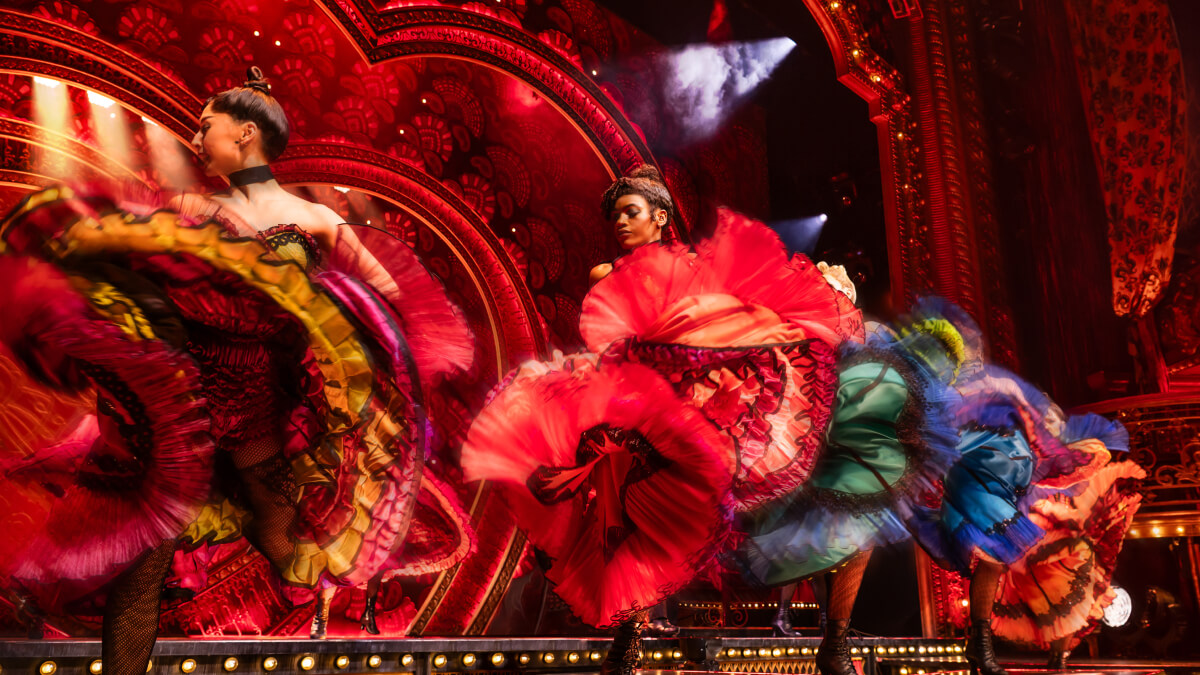
There is no show in the West End that tries harder to make you forget you are watching a show, and for long stretches it succeeds magnificently. Arrive early, drink it in, and enjoy the spectacle while it lasts, because once the plot gets going, so does your patience.
Moulin Rouge! is Alex Timbers’s stage adaptation of Baz Luhrmann’s vertiginously stylised 2001 film, with a book by John Logan and music supervision by Justin Levine. Set in the Montmartre quarter of Paris in 1899, it follows Christian, a wide-eyed American writer who falls helplessly in love with Satine, the dazzling star courtesan of the Moulin Rouge nightclub. Their romance, conducted in borrowed song lyrics, is complicated by the scheming of Harold Zidler, the club’s florid, panic-stricken impresario, and The Duke of Monroth, a wealthy villain who believes that everything, including Satine, can be bought. The cabaret is on the brink of financial ruin, and Zidler needs the Duke’s money to save it. Meanwhile Christian writes a show-within-the-show, Satine is dying, and nobody has time to develop a personality.
What the production does have, in almost offensive abundance, is spectacle. Derek McLane’s scenic design extends well beyond the stage into the entire Piccadilly Theatre: a crimson cathedral of velvet drapes, heart-shaped cutouts, chandelier forests, and the twin totems of the real Moulin Rouge, a windmill and an elephant, flanking the proscenium. You will spend the pre-show twenty minutes discovering details. It is easily the finest immersive set in the West End, and nothing else comes close. Catherine Zuber’s costumes match it beat for beat, and Justin Townsend’s lighting, particularly the Act Two opening, which ruptures into strobing neon chaos as the ensemble tears into a Lady Gaga medley, is precisely calibrated to keep the audience from catching breath.
The score, the show’s other genuine triumph, folds over seventy songs across the evening. Justin Levine’s arrangements are frequently inspired: a Rolling Stones double-header handed to the Duke turns villainy into strutting fun, and the Act One number in which the entire company gives itself over to absinthe-fuelled delirium, surfing through Sia’s Chandelier. When these mashups work, they are the reason jukebox musicals exist. Come What May, the show’s one original song, inherited from the film, remains its purest emotional beat, and the moment it arrives in Act Two still earns its keep.
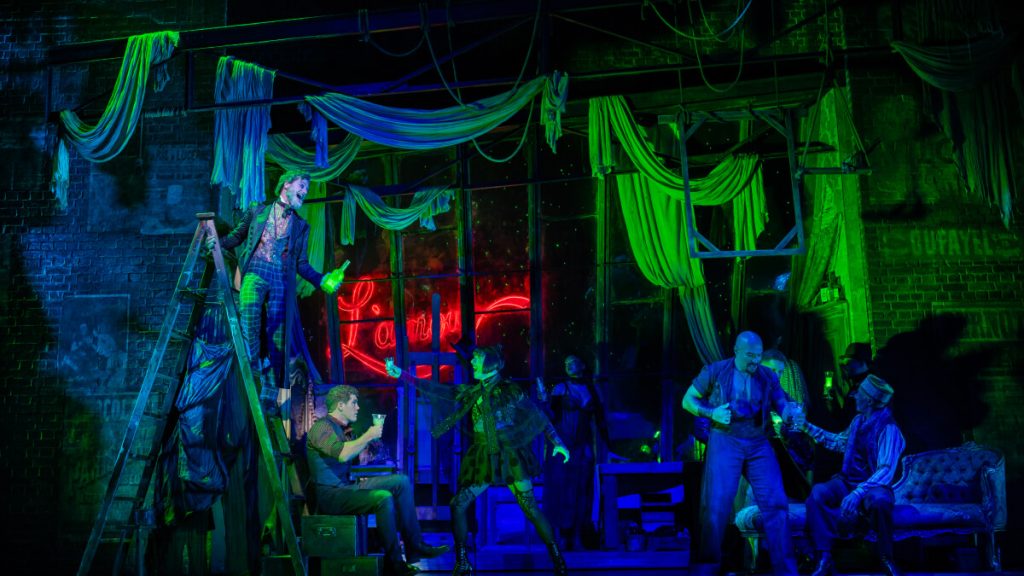
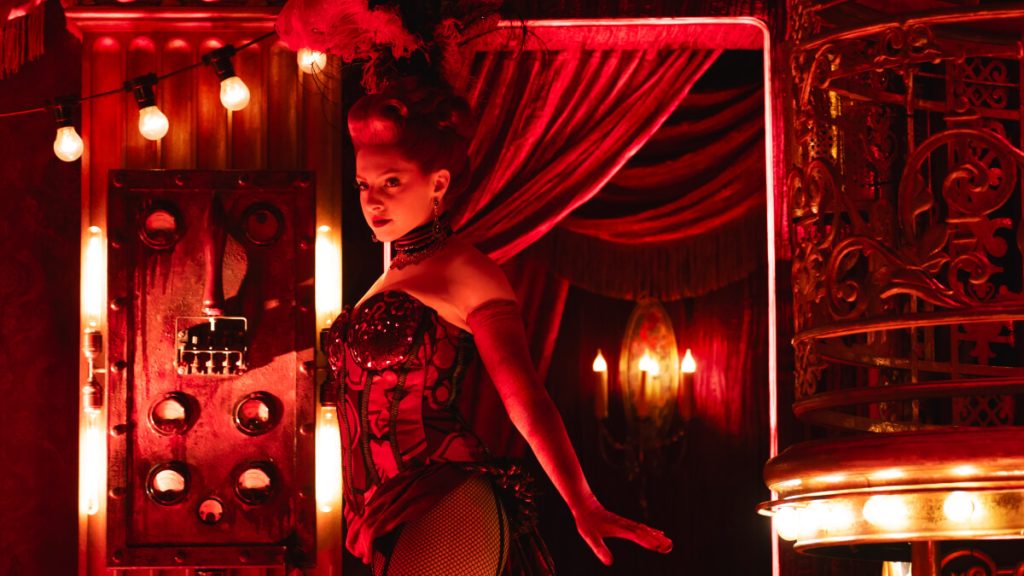
What the current cast cannot quite manage is to make any of this feel urgent. Karis Anderson brings genuine vocal firepower to Satine and handles the Act One Sparkling Diamonds entrance with authority, descending into the room with the poise the role demands. But there is a settled quality to the performance that sits just short of electric, you admire it more than you are moved by it. Alistair Brammer’s Christian is earnest and technically accomplished, yet the pair never quite generate the kind of chemistry that makes the tragedy land with real weight. A love story for the ages, the poster promises. In the hands of the current leads, it is more like a love story for a pleasant evening. Ben Richards as The Duke, now well into his tenure with the production, delivers his oily menace on comfortable autopilot, watchable, amusing, but no longer dangerous. The ensemble, to their credit, never drops the energy, and Sonya Tayeh’s choreography, all coiled precision and barely controlled ecstasy, remains the production’s most reliable source of genuine excitement.
John Logan’s book is the problem nobody mentions and everybody senses. The emotional beats arrive on schedule because musicals have schedules, not because the characters have earned them. Satine’s condition is announced and then largely set aside until it becomes dramatically convenient; the Duke’s menace is broad enough to pantomime; and Christian’s journey from naïve idealist to heartbroken witness is compressed to the point where you register rather than feel it. The show is not trying to be Sondheim, and fair enough, but even on its own terms, the book is thin scaffolding for such an enormous structure.
There will, inevitably, be a standing ovation. The audience will have been expertly softened up by two and a half hours of sensory bombardment, and standing will feel like the only appropriate physical response to so much noise and light. The show earns that ovation, but for its stagecraft rather than its soul. Moulin Rouge! is a brilliant production of a middling show, and at this point in its run, a production somewhat on cruise control. If you are yet to see it, the set alone justifies the ticket price. If you saw it early, with the original London cast, perhaps let the memory do the heavier lifting.
Want to know the best seats for Moulin Rouge? Click here…