

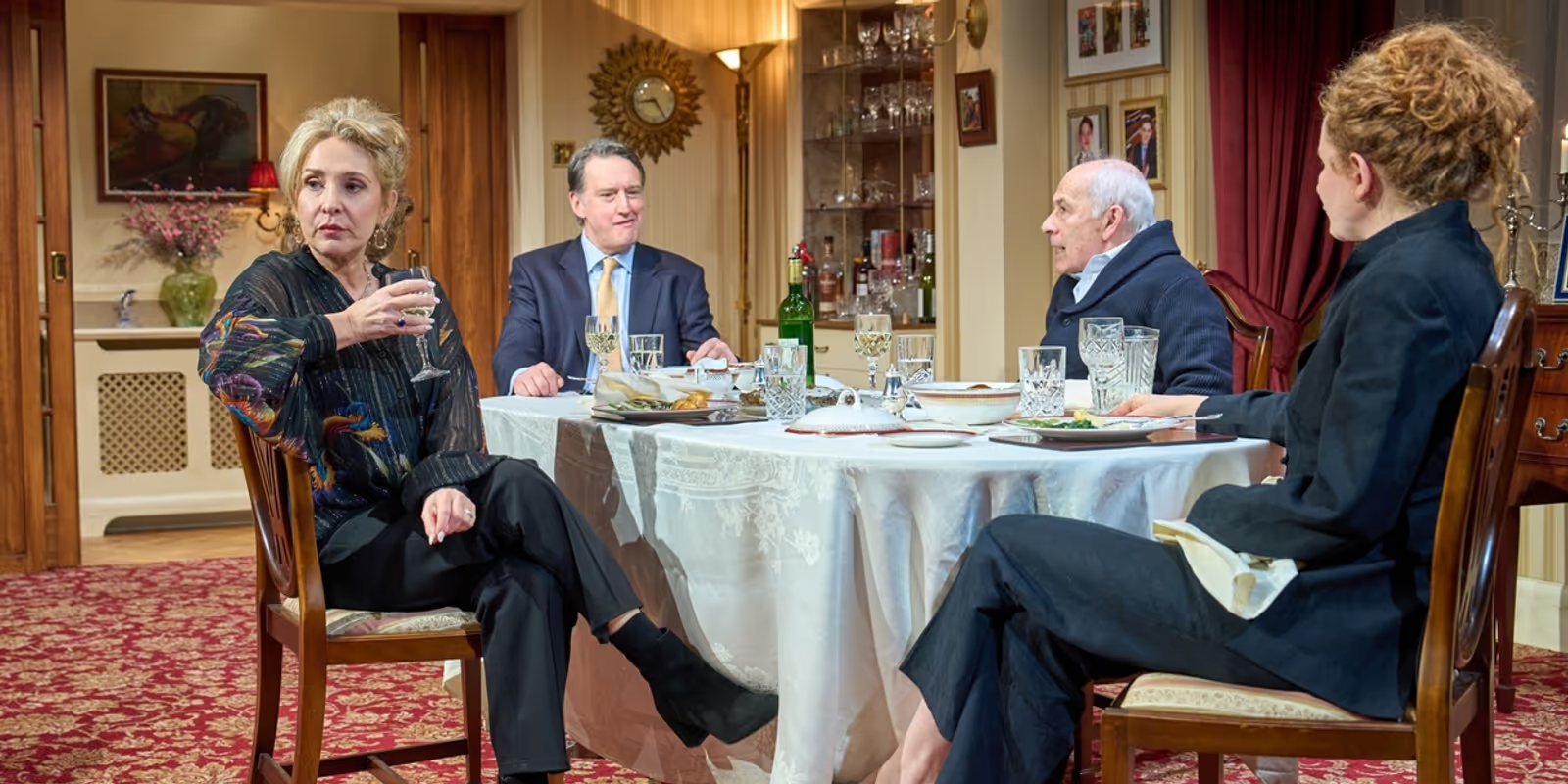
Ryan Craig’s The Holy Rosenbergs is one of those rare plays that trusts its audience enough to leave them genuinely unsettled. Written in the shadow of the Intifada, this revival at the Menier Chocolate Factory arrives now, against the backdrop of Gaza, with the force of a piece that knew it would be back.
The Rosenbergs are a North London Jewish family collapsing under the weight of irresolvable questions. Their eldest son has died in combat defending Israel, a death that pulls the surviving family together for a single evening and tears them methodically apart. David, the father, is a catering company owner whose business is failing; Lesley, the mother, manages the room the way she manages everything, with food, noise, and compulsive hospitality; and Ruth, the daughter, is a civil rights lawyer who has spent her career on the legally and morally awkward side of the Israel-Palestine argument.
Into this comes Saul Morganstern (old family friend, hospital consultant, and chair of the local synagogue) and, later, a far more explosive arrival that I will leave to the production to deliver. Craig gives each of these positions a fully functioning human face. You find yourself yo-yoing between them, persuaded first by one argument, then the other, and the play’s great achievement is that it never quite lets you settle.
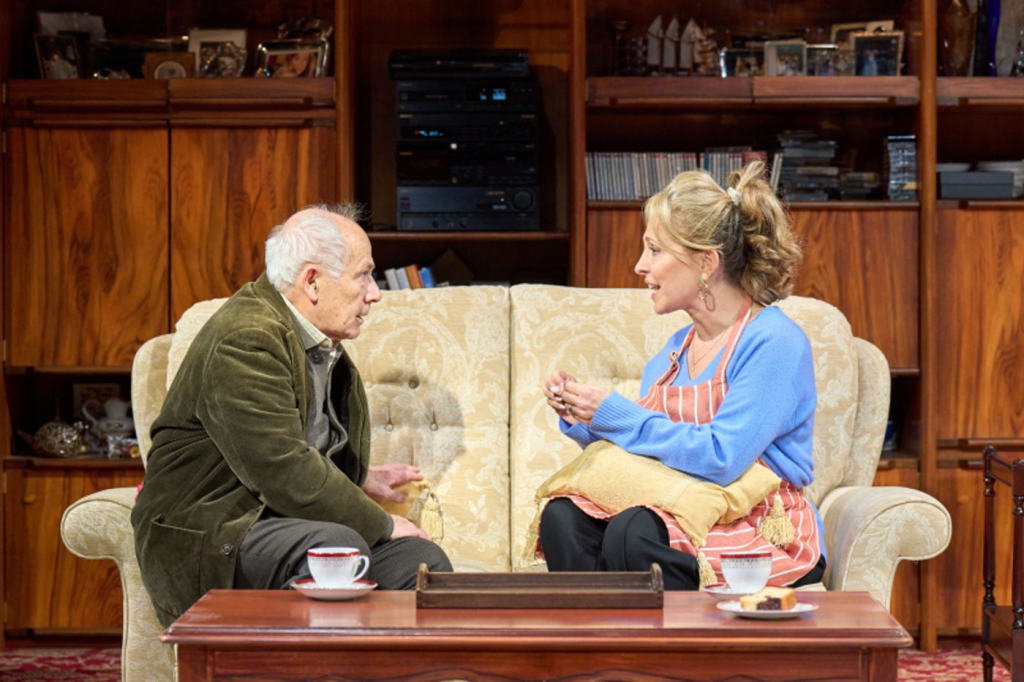
After a slightly tentative first five minutes, a brief exchange between two minor characters that does little to earn its place, Lindsay Posner’s production finds its footing quickly and does not release it. The direction is disciplined and clear. This is an evening that knows exactly what kind of evening it is: family drama, political argument, and dark comedy in uneasy but controlled coexistence. The storytelling is easy to follow without ever feeling engineered.
Tim Shortall’s set is doing serious work. The Rosenbergs’ North London sitting room is detailed and specific: Judaica on the shelves, a Yahrzeit candle burning for the dead son, and, through the bay window, a glimpse of ordinary street life that slowly darkens as the evening progresses. It is an elegant, unobtrusive piece of design, marking time without announcing itself.
Tracey-Ann Oberman as Lesley is exceptional. The performance is neurotic, funny, and heartbreaking in equal measure, and absolutely specific in its physical choices: her hands never stop moving, food perpetually deployed as displacement activity, her attention darting from argument to argument like a woman trying to put out fires in a burning building. Nicholas Woodeson as David lands the precise register of a man whose confidence is a performance he can no longer quite sustain, vulnerable beneath the authority, reaching for loyalty he believes was paid for long ago. Dorothea Myer-Bennett as Ruth is sharp, intelligent, and wisely refuses to make her character’s position either comfortable or easy.
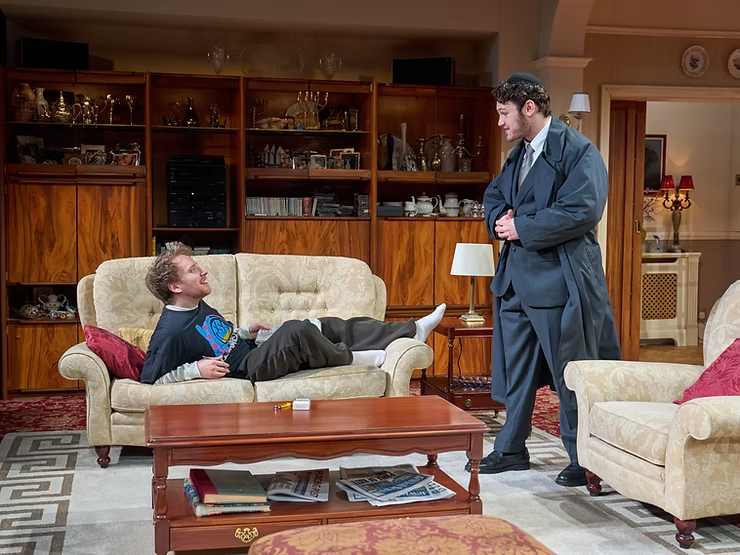
A scene in the second half captures what Craig is doing at his best. David rounds on Saul for failing to support his failing catering company: forty years ago, he argues, he shielded Saul from childhood bullies, and the debt is permanent. Saul’s response (that the past is the past and he owes nothing) lands like a slap. David’s absolute conviction that old protection creates a lifelong claim, and Saul’s breezy dismissal of the ledger, is the Israel-Palestine argument played out in miniature inside a sitting room.
There are weaknesses. Dan Fredenburgh’s Saul Morganstern is misjudged in performance: a hospital consultant who delivers bad news for a living handles an awkward social conversation as though it is the most difficult thing he has ever done. It drains a scene of credibility that the production has otherwise worked hard to earn. Alex Zur’s Rabbi Simon is a structural problem too, a character whose lines feel like they are doing thematic heavy lifting the play has already managed more deftly elsewhere, and no performance could fully rescue material that is pulling against itself.
These are minor quibbles. They do not derail an evening of considerable moral seriousness. When the late, unexpected arrival appears in the doorway, handled with superb, deliberate understatement, the room went entirely still. The standing ovation at the end was earned. This audience, many of them visibly and personally invested in the subject matter, sat through it in one of the most physically punishing auditoria in London without appearing to move. That some of the play’s references (a throwaway nod to Honeypot Lane among them) will land harder for NW London Jews than for anyone else is simply true, and worth knowing in advance. The central questions, though, belong to anyone willing to sit with genuine moral discomfort and resist the urge to resolve it too quickly.
It is a limited run. There are still seats available, and anyone serious about theatre that does not flinch should be in that room before it closes.