

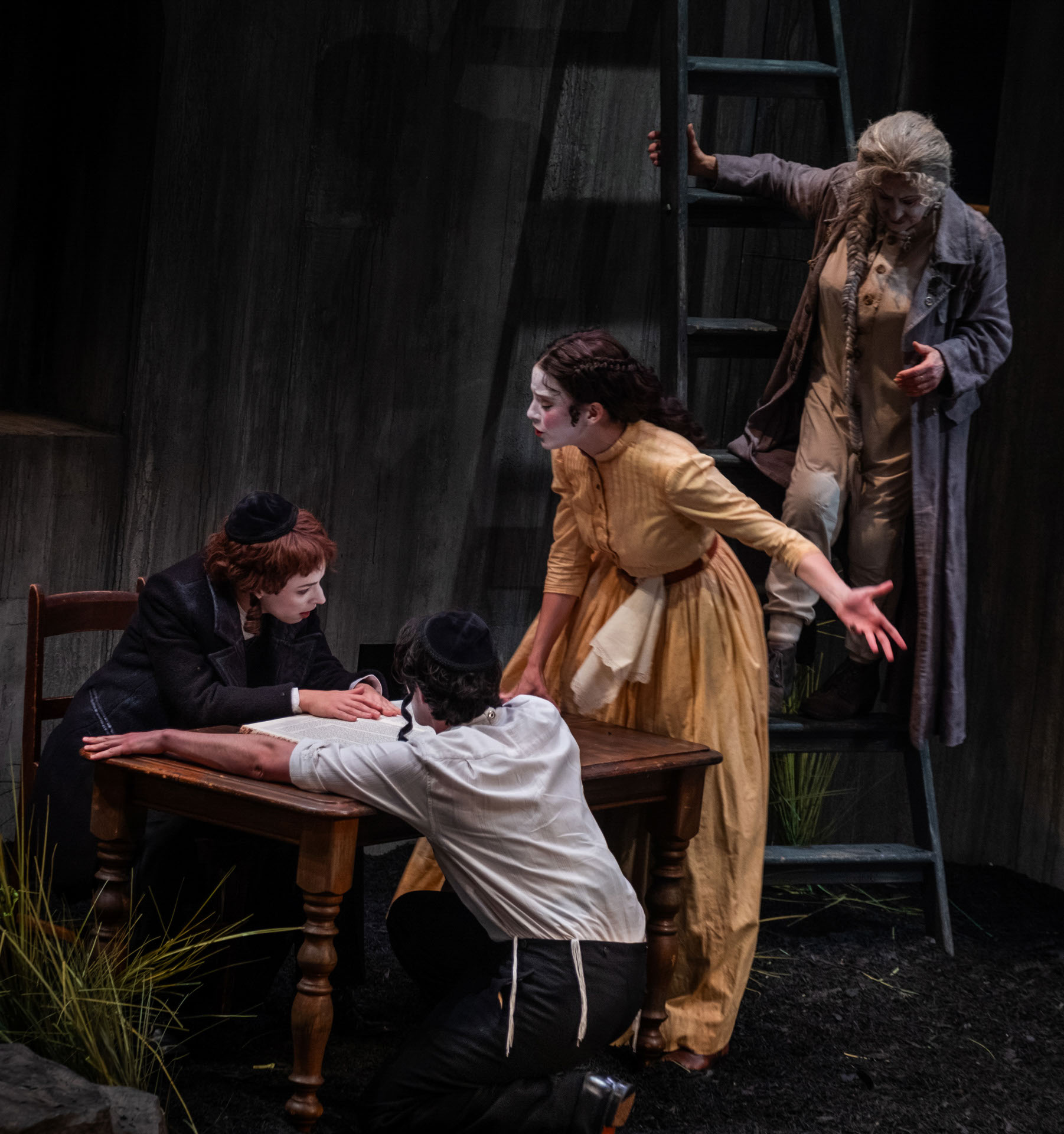
There’s a production lurking inside this Yentl that fully earns the five-star raptures it collected in Melbourne and Sydney – and occasionally, gloriously, you catch a gleam of it. But somewhere between Sydney Opera House and the back end of Baker Street, something of that electric charge has vanished.
Kadimah Yiddish Theatre’s bilingual drama – adapted from Isaac Bashevis Singer’s 1962 short story by director Gary Abrahams, Elise Esther Hearst, and Galit Klas – is emphatically not the Barbra Streisand film, a distinction the production announces early and often. Singer himself was famously unimpressed by that version, and one suspects the Nobel laureate would have had further notes about a casting that gave Mandy Patinkin – one of the more formidably talented actor-singers of his generation – considerably less to do than his gifts warranted. This staging returns to the darker, stranger source material with relish.
Set in a 19th-century Polish shtetl, it follows Yentl, a young Jewish woman forbidden by Orthodox law from studying the Torah, who disguises herself as a man – taking the name Anshel – and enrols at a yeshiva. There she becomes intimate study partners with Avigdor, falls for him, and then compounds the situation spectacularly by agreeing to marry Avigdor’s former fiancée Hodes, a woman who grows increasingly suspicious that something about her new husband doesn’t quite add up.
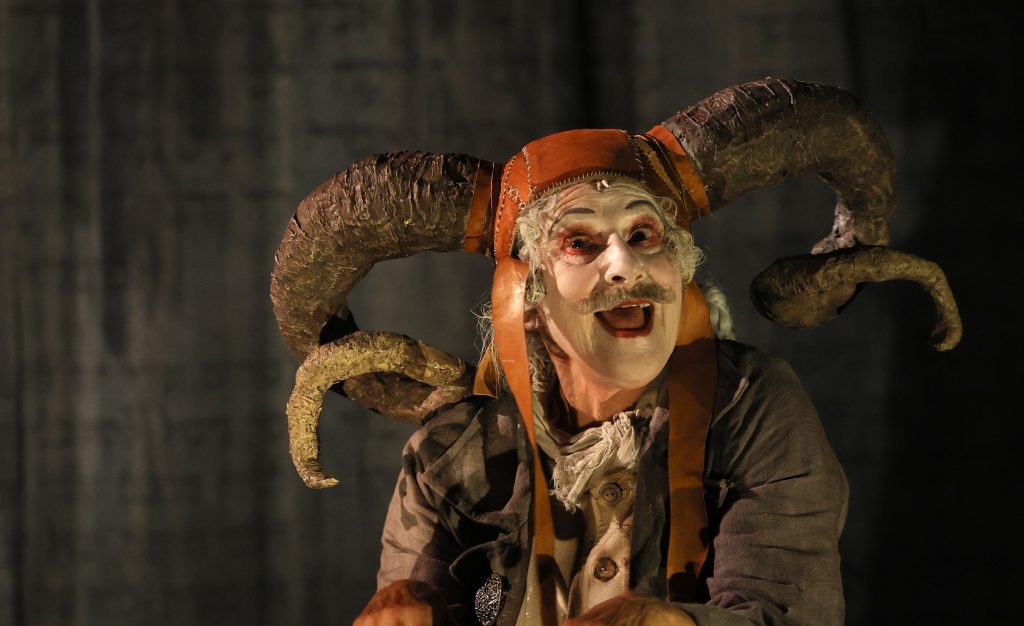
The evening belongs to Evelyn Krape as The Figure, a narrator-provocateur who is part Greek chorus, part panto dame, and entirely possessed by something that trained with distinction at clown school (and I mean that in a good way). Krape’s physical intelligence is extraordinary – she moves through the piece on crooked limbs, her body seemingly organised around a different set of joints from the rest of the cast, and her comic timing is calibrated to the millisecond. She is at her most electric in a first-half sequence where she plays narrator, Yentl’s dead father, and something approaching a dybbuk inside the same breath, toggling between registers without losing a thread. The problem is she rarely leaves the stage, and in the second half there’s a point where the production commits what might be called theatrical overstaying.
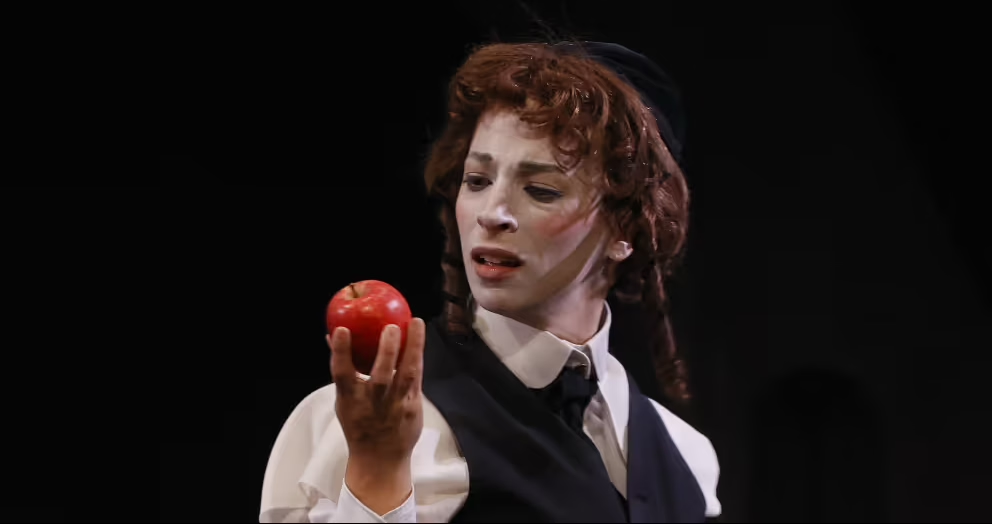
Amy Hack carries the title role with quiet authority. Her best moment comes late – a confession scene with Avigdor in which she allows Yentl’s exhaustion to surface, very still. Ashley Margolis’s Avigdor has a pleasing earthiness – less romantic hero than horny scholar who, as one of the play’s sharper jokes establishes, treats marriage largely as a logistical solution to getting laid as often as he can. The pair generate genuine warmth. Genevieve Kingsford does what she can with Hodes, but the writing has decided her function is to embody the conventional path not taken, and the character never escapes that constraint.
The bilingual structure – English and Yiddish, with surtitles projected onto Dann Barber and Isabella Van Braeckel’s spare, ashen set – works better than you might expect. The language shifts feel organic rather than self-conscious, and the theological debates between Anshel and Avigdor crackle in the first half. The difficulty is that the second half settles into an earnest rumination that the pacing can’t sustain. A production that fizzes so brilliantly in parts eventually starts to feel like a lecture it doesn’t need to give. Singer’s original story is only twelve pages long. The expansion is often inspired, but sometimes it reminds you of the word count.
There is also nudity, deployed at one point when Avigdor decides that a pre-swim costume change is an optional extra. It fits well enough within the production’s sensibility – the show has a frank, unsentimental relationship with bodies throughout – though one could argue the moment makes its point without quite needing to make it quite so literally. And when Anshel takes her top off (‘look, I’ve got breasts’), it feels unnecessarily worked in.
A practical note for anyone booking: the Marylebone Theatre’s demographic skews toward an audience that could have personally witnessed several of the historical events the play depicts, and navigating the interval queue for the toilet or a drink is an exercise in patience that could defeat even the most desperate theatregoer’s bladder. Factor it in.
Worth seeing, especially for Krape. Just go in knowing that this Yentl burns brightest in the moments when it forgets to explain itself.