

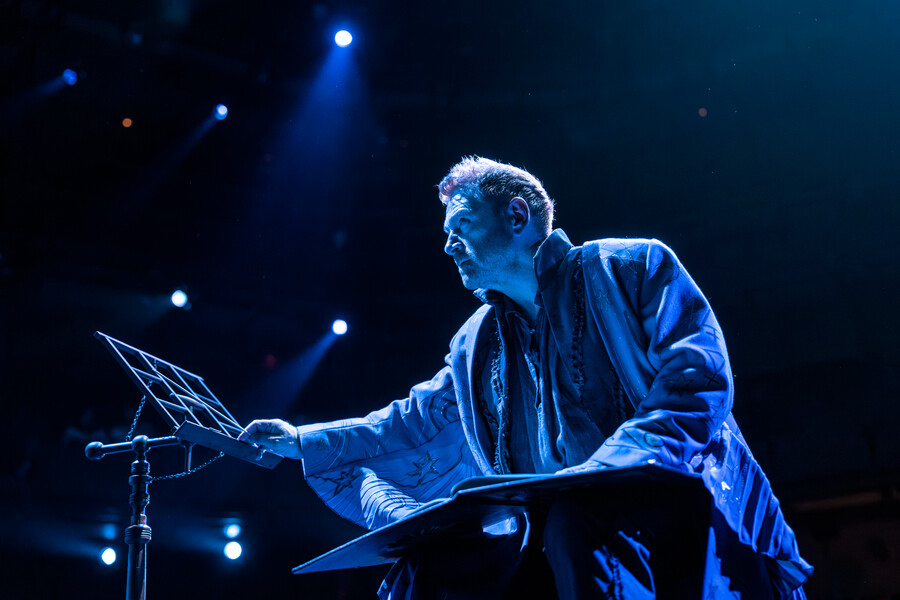
This is a Tempest that gives you everything you came for. Kenneth Branagh’s long-awaited return to Stratford is a genuine event, but the production around him doesn’t always know what to do with him.
The Tempest is Shakespeare’s likely swansong as a solo author, and it wears its fairy-tale bones on the outside: a deposed Duke, a desert island, a storm summoned out of spite and something closer to grief. Prospero, driven from Milan by his usurping brother Antonio, has spent years in exile with his daughter Miranda, ruling over the spirit Ariel and the enslaved Caliban with a mixture of tenderness and tyranny. When a ship carrying his old enemies passes near his shore, he raises the tempest that gives the play its name and sets his long-delayed reckoning in motion.
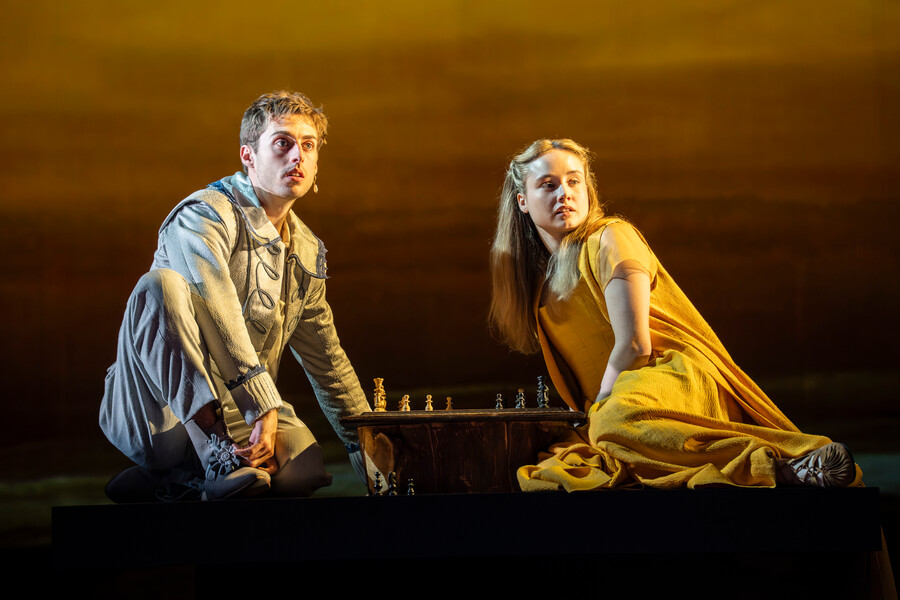
That reckoning unfolds gradually. Antonio and the King of Naples, Alonso, believe Alonso’s son Ferdinand has drowned in the wreck, while Sebastian eyes his brother’s crown with the kind of ambition islands seem to encourage in men who ought to know better. Ferdinand, alive and washed up alone, stumbles into Miranda’s company and into an infatuation Prospero has been quietly engineering all along. Elsewhere on the island, the drunken butler Stephano and the jester Trinculo fall in with Caliban in a scheme so poorly conceived it barely counts as a plot, though it supplies most of the evening’s broadest laughs. Prospero, meanwhile, watches all of it from somewhere just off center, testing his enemies, testing his daughter, and slowly talking himself out of vengeance.
Richard Eyre, 83 years old and somehow only now making his Stratford debut, stages Prospero as a conductor, his staff a baton, his book of spells a musical score. It’s a properly inspired image, one that pays off gorgeously in the opening storm, where the cast are flung about a tilting stage as thunder crashes on Branagh’s downbeat. The trouble is that Branagh himself seems undecided about which Prospero he’s conducting. In the island scenes he can feel oddly becalmed, almost bored, as though he’s saving something for later. When later arrives, in the great renunciation speech where Prospero finally lays down his rough magic, he turns the power up so suddenly it plays less like release than a change of gear. It’s a performance full of isolated brilliance that never quite finds a single throughline, though when he’s on, nobody in the building is watching anyone else.
Fortunately the company around him doesn’t wait for him to catch up. Ruby Stokes gives Miranda genuine, unforced curiosity rather than the usual wide-eyed blankness, and her courtship scenes with Fred Woodley Evans’ amiably out-of-his-depth Ferdinand have a warmth that the rest of the production could use more of. Ashley Zhangazha plays Caliban with real dignity, resisting the temptation to make him monstrous, which sharpens rather than softens the production’s interest in who exactly is enslaving whom. Guy Henry and Keir Charles, as Stephano and Trinculo, do the unglamorous work of making the comic subplot bearable, and mostly succeed.
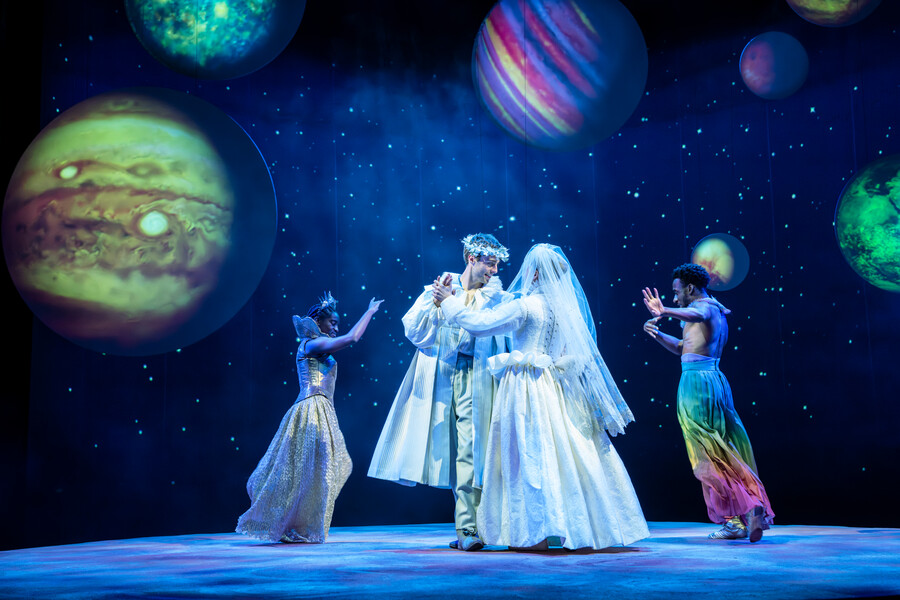
Where the production loses its nerve is in the connective tissue between the big moments, where scenes can rush past as though the interval is a train Eyre is worried about missing. Anyone who saw the RSC’s more patient, slower-burn Tempest a few seasons back may find themselves missing that version’s willingness to let silence do some of the storytelling. The music, all conducting metaphors and swirling underscore, occasionally strays close to pageantry when what the moment needs is stillness.
None of this stops the evening from working, exactly, so much as it stops the evening from soaring the way it clearly wants to. There’s a real production in here, visually inventive and full of talented people doing good work, and there’s a star performance that keeps threatening to arrive in full and then retreating into itself. Such stuff as great theatre is made on needs a little more consistency than this. Go for Branagh, and don’t expect every scene to earn its keep along the way.